

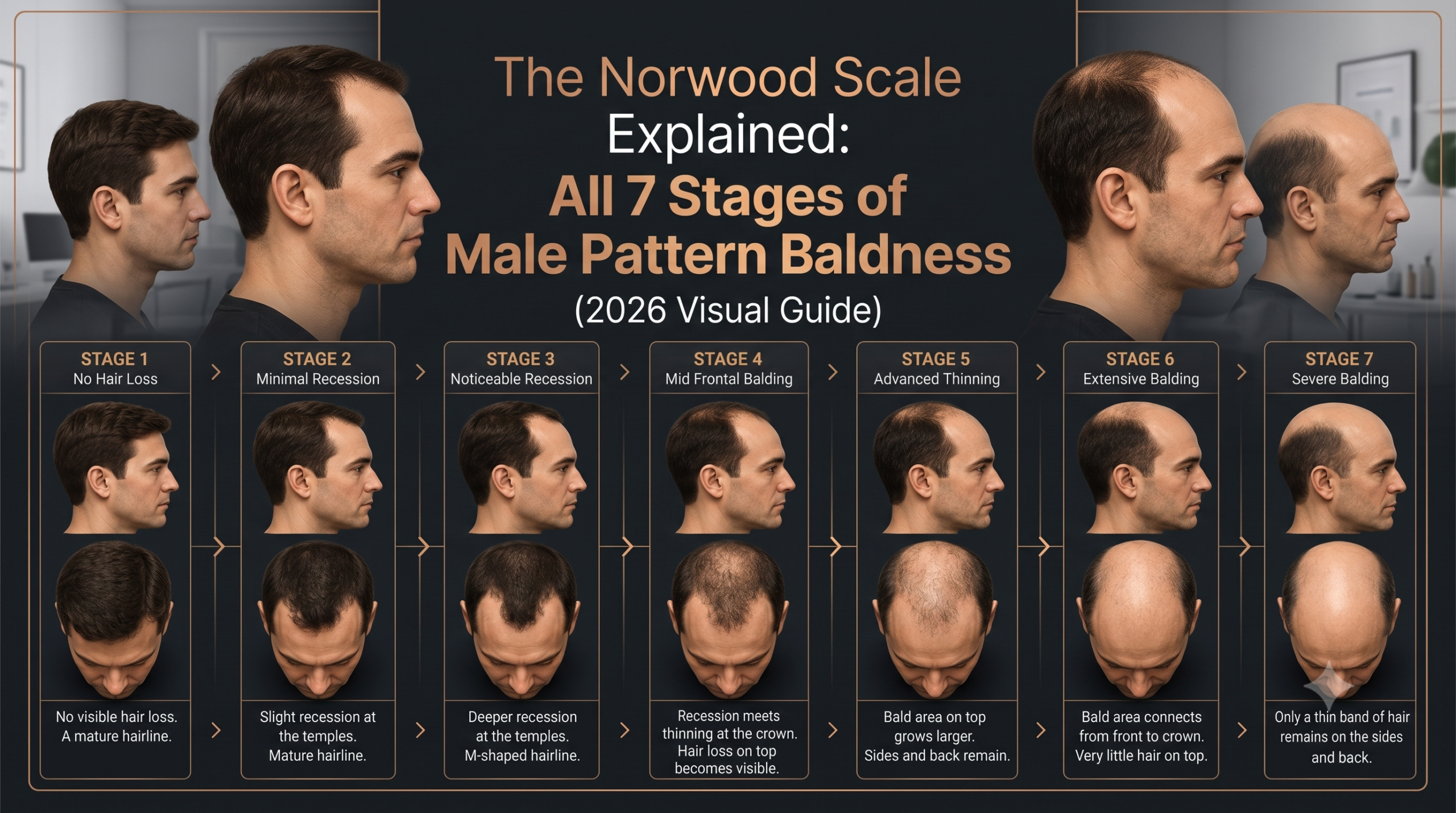

Quick Answer: The Norwood scale (also called the Hamilton-Norwood scale) is the standard classification system for male pattern baldness, dividing hair loss into 7 stages. Stage 1 shows no visible recession, stage 3 is the first stage considered “balding,” and stage 7 is the most advanced, leaving only a horseshoe of hair around the sides and back. Clinics worldwide use The Norwood scale to plan treatment and estimate graft numbers for hair transplants.
The Norwood Scale – Key Takeaways
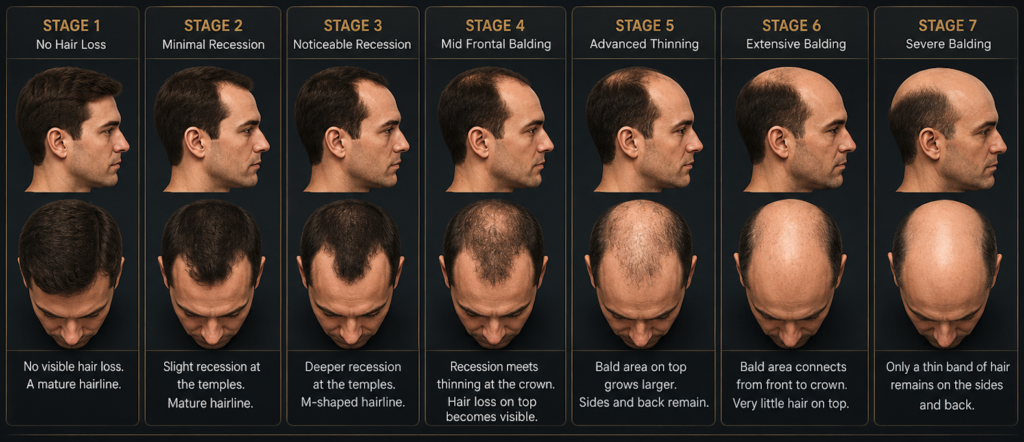
- The Norwood scale runs from stage 1 (no recession) to stage 7 (only a horseshoe band of hair remains); stage 3 is the clinical threshold for “balding.”
- Men typically bald first at the temples (temporal recession) and at the crown (vertex thinning), which is why the scale tracks both zones.
- Graft requirements roughly double across the scale: a Norwood 2 hairline may need 1,000-1,500 grafts, while a Norwood 6-7 case can require 5,000-6,000+.
- Transplant candidacy usually starts at Norwood 3; stages 1-2 are typically managed with medication, and even Norwood 7 can be treatable if the donor area is strong.
- The scale was designed for men; female pattern hair loss is measured with the Ludwig scale instead.
- Understanding The Norwood scale helps patients recognize where they stand before considering treatment.
If you have ever typed “what norwood stage am I” into Google at 11 p.m. after catching your hairline in a bathroom mirror, you are in good company. The norwood scale is one of the most searched hair loss terms online, and for a simple reason: before you can decide between doing nothing, taking medication, or booking a transplant consultation, you need to know where you actually stand. This guide walks through all 7 male pattern baldness stages, shows you how to self-assess, and maps realistic graft numbers to each stage.
What Is the Norwood Scale?
The Norwood scale is a 7-stage classification system that describes how male pattern baldness (androgenetic alopecia) progresses, from a full juvenile hairline to near-total loss on top of the scalp. It is the most widely used norwood classification tool in hair restoration clinics, dermatology practices, and research studies today.
Hamilton vs. Norwood: Where the Classification Came From
The system has two authors, decades apart. Dr. James Hamilton first published a baldness classification in 1951 after studying hair loss patterns in several hundred men. In 1975, Dr. O’Tar Norwood revised and expanded the Norwood classification system, adding the now-familiar stage structure and the “A variant” patterns.. That is why you will see it written three ways: the norwood hamilton scale, the hamilton norwood scale, or simply the Norwood scale. All three refer to the same system.
Why Clinics Rely on It
A shared scale gives patients and surgeons a common language. Instead of “my hairline is going back a bit,” a clinic can note “Norwood 3 with early vertex thinning” and immediately understand three things:
1. How far the loss has progressed and which zones (hairline, mid-scalp, crown) are affected
2. How it is likely to progress if left untreated, since androgenetic alopecia follows predictable patterns
3. How many grafts a transplant would realistically need, which drives cost and surgical planning
The scale also matters for expectation-setting. A surgeon planning coverage for a Norwood 5 patient makes very different density decisions than for a Norwood 2, and knowing this before a consultation protects you from clinics that promise identical results to everyone.
Where Balding Starts: The Two Zones That Matter
Men first go bald in two specific places: the temples (the corners of the hairline above the eyebrows) and the vertex, or crown (the swirl point at the top-back of the head). Almost every case of male pattern baldness begins in one or both of these zones, which is exactly what the Norwood scale tracks. This is why The Norwood scale remains the reference tool used in hair restoration planning.
The typical sequence looks like this:
1. Temporal recession: the hairline pulls back at the corners, creating an “M” or widow’s-peak shape
2. Vertex thinning: the crown swirl widens into a visible thin spot, often noticed first in photos or under bright light
3. Bridge breakdown: the strip of hair separating the front from the crown thins until the two bald areas merge
4. Side progression: the remaining top hair recedes downward until only the horseshoe band remains
Not every man follows the full sequence. Some recede only at the front for decades; others keep a strong hairline while crown balding advances quietly behind it. Genetics decide the route, but the destinations are consistent enough that the scale has held up for 50 years.
The 7 Norwood Stages Explained
The 7 stages of the Norwood scale move from no visible loss (stage 1) through progressive recession and crown involvement (stages 2-5) to advanced baldness (stages 6-7). Here is what each stage actually looks like, with the single-line diagnostic criterion clinics use.
Stages 1-3: Early Recession
Norwood 1 shows no significant recession. The hairline sits at or near the juvenile position, and the crown is full. Diagnostic cue: hairline is roughly straight across with minimal corner recession; crown fully covered. A mature hairline (which sits about 1-1.5 cm above the juvenile line and develops in most men during their 20s) still counts as Norwood 1. It is aging, not balding.
Norwood 2 shows mild, symmetrical recession at the temples. The classic norwood 2 hairline forms a shallow “M” or slight widow’s peak. Diagnostic cue: temple corners have receded up to about 2 cm, but the mid-frontal hairline holds; crown untouched. It sits in a gray zone between a mature hairline and true pattern loss, and if you compare norwood 2 examples online, you will notice many men stay at this stage for life.
Norwood 3 is the first stage classified as balding. The temporal recession deepens into a clear “M,” “U,” or “V” shape with sparse or bare corners. Diagnostic cue: temple recession extends past an imaginary vertical line drawn 2 cm in front of the ear canal; crown may still be full. Norwood stage 3 is also where most men first seek treatment, and where transplant candidacy typically begins.The Norwood scale helps surgeons determine the appropriate treatment strategy by evaluating the extent and progression of hair loss.
Norwood 3 vertex is a subtype worth knowing: the hairline sits at stage 2-3, but a distinct thin spot has opened at the crown. This vertex thinning variant is common in men in their 30s and 40s and often progresses faster than front-only recession.
Norwood 2 vs. Stage 3: The Line That Matters
The practical difference between norwood 2 and norwood 3 comes down to depth and density. At stage 2, the corners have pulled back but still hold reasonable density; at stage 3, the corners are visibly sparse or bare and the recession clearly reshapes the hairline. If you can see scalp through the temple corners in normal indoor lighting, you are likely at stage 3 or beyond. This distinction matters because most surgeons treat stage 2 with monitoring or medication, while stage 3 opens the door to surgical planning.
Stages 4-5: Crown Involvement
Norwood 4 brings the crown into play. Frontal recession is now severe, and a bald or thinning patch has established itself at the vertex. Critically, a solid band of hair still separates the two areas. Diagnostic cue: two distinct loss zones (front and crown) divided by a clear bridge of hair across the mid-scalp. Norwood 4 is one of the most common presentations in transplant clinics, typical of men in their 40s.
Norwood 5 is stage 4 with the bridge failing. The band separating front and crown becomes narrow and thin, and the two bald areas begin to visually merge. Diagnostic cue: the dividing strip of hair is still present but noticeably sparse; front and crown loss zones almost touch. At this stage the total bald surface area is large, and treatment planning shifts from “restore the hairline” to “distribute coverage intelligently.”
Stages 6-7: Advanced Loss
Norwood 6 means the bridge is gone. Front and crown baldness have merged into one continuous bald area covering the top of the scalp, with hair remaining only on the sides and back. Diagnostic cue: no separating band; a single bald zone from hairline to crown, sides still relatively high.
Norwood 7 is the most advanced stage. Only a horseshoe-shaped band of hair remains around the sides and back of the head, and even this band is often thinner and finer than before. Diagnostic cue: bald scalp extends down the sides; remaining hair forms a low horseshoe from ear to ear around the back.
Can Norwood 7 Be Treated?
Yes, Norwood 7 is treatable, but with conditions. Surgery is only realistic if the donor area (the horseshoe band) still has sufficient density, and expectations must shift from full restoration to strategic coverage: a natural frame for the face and lighter density behind it. Many Norwood 7 cases need 6,000+ grafts across two sessions, sometimes supplemented with body hair grafts. A candid clinic will tell you upfront whether your donor supply supports the plan; a bad one will promise density it cannot deliver.
The Norwood A Variants
The “A” variants (2A through 5A) describe men whose hairline recedes straight back as one front, without the surviving forelock island in the middle and without separate crown balding. This is a less common pattern, and it matters for planning: A-variant patients often need more grafts at the front earlier, since the entire frontal band retreats at once.
How to Identify Your Own Norwood Stage
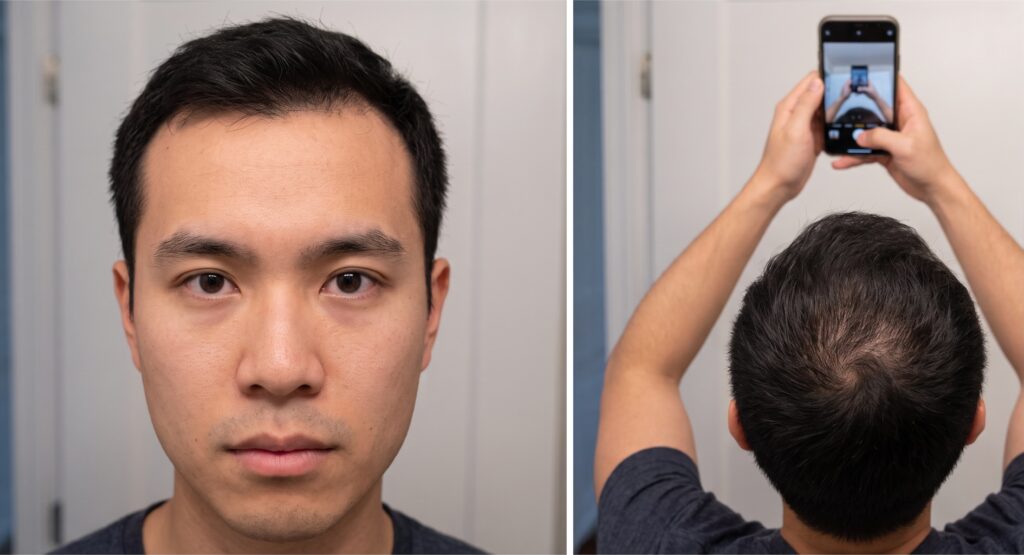
You can estimate your Norwood stage at home in about two minutes using two photos: one of your hairline from the front and one of your crown from above. Work through this checklist:
1. Photograph your hairline straight-on in even, indirect light (harsh overhead light exaggerates thinning; dim light hides it).
2. Photograph your crown by holding your phone above and behind your head, or ask someone to take it.
3. Check the temples. No corner recession = stage 1. Mild, even recession with a soft “M” = stage 2. Deep, sparse corners = stage 3+.
4. Check the crown. A widening swirl or visible scalp at the vertex adds “vertex” to your stage (e.g., 3 vertex) or pushes you toward stage 4.
5. Check the bridge. If front and crown loss are separate zones, you are at stage 4. Thin connecting strip = stage 5. Merged = stage 6. Loss extending down the sides = stage 7.
6. Compare against 6-12 month-old photos. The scale describes a snapshot; the trend tells you whether you are progressing.
One practical note most self-assessments miss: wet hair and short clipper cuts both reveal roughly one stage more loss than styled dry hair shows. If you want an honest reading, assess with clean, dry, unstyled hair.
A self-diagnosis gets you close, but borderline cases (2 vs. 3, or 4 vs. 5) genuinely benefit from a professional scalp analysis, ideally with trichoscopy, since miniaturizing hairs signal where the pattern is heading next.
How Many Grafts per Norwood Stage?
Graft requirements rise steeply with each Norwood stage, from roughly 800 grafts for minor temple work to 6,000 or more for advanced loss. The table below shows the ranges most experienced clinics quote. Treat them as planning estimates: your hair caliber, color-to-skin contrast, head size, and density goals all shift the final number.
| Norwood Stage | Typical Loss Pattern | Estimated Grafts Needed |
| Stage 1 | No significant recession | 0 (not a transplant candidate) |
| Stage 2 | Mild temple recession | 500-1,500 (often optional) |
| Stage 3 | Deep frontal recession | 1,000-2,000 |
| Stage 3 vertex | Stage 3 + crown thinning | 1,500-2,500 |
| Stage 4 | Frontal loss + distinct crown bald spot | 2,000-3,500 |
| Stage 5 | Large zones, thinning bridge | 3,000-4,500 |
| Stage 6 | Merged front-to-crown baldness | 4,000-5,500 |
| Stage 7 | Horseshoe pattern only | 5,000-6,000+ (often 2 sessions) |
Two caveats keep these numbers honest. First, thick, wavy, low-contrast hair can create a fuller look with 20-30% fewer grafts than fine, dark hair on pale skin. Second, donor capacity is finite: most men have 6,000-8,000 safely extractable grafts in a lifetime, which is why stage 6-7 plans prioritize the hairline and mid-scalp and accept lighter crown density. You can see how transplanted density actually matures in this overview of hair transplant results by stage.
Which Norwood Stages Are Candidates for a Transplant?
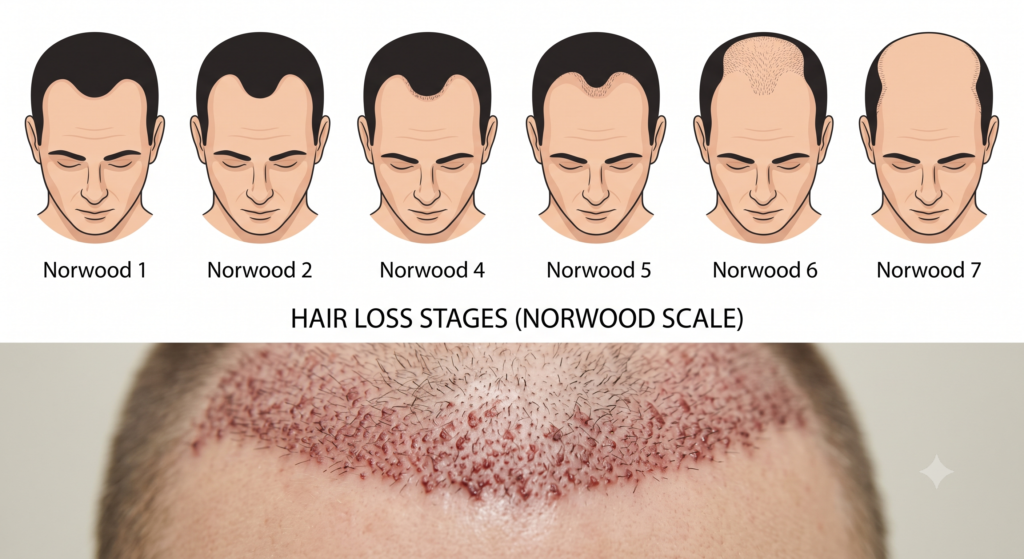
Norwood 3 is generally the earliest stage where a hair transplant is recommended; stages 3 through 6 are the classic candidacy window, and stage 7 remains possible when donor density allows. Stages 1-2 are almost always better served by monitoring and medication, for a simple reason: transplanting into an area that is still actively losing native hair often means chasing the recession with repeat surgeries.
A practical way to think about it:
- Norwood 1-2: Preserve what you have. Clinically studied options like finasteride and minoxidil (used under the guidance of a prescribing physician) can slow or partially reverse early loss in many men. Surgery now usually means surgery again later.
- Norwood 3-5: The sweet spot. Loss is established enough to plan around, donor supply is typically strong, and a single well-designed session can restore the frontal frame. Techniques differ in how the hairline is built; the differences are covered in this comparison of DHI versus FUE techniques.
- Norwood 6-7: Still treatable, with adjusted expectations. Coverage strategy, possible staged sessions, and honest density planning become decisive. Donor management matters more here than anywhere else.
Age interacts with stage, too. A 43-year-old at Norwood 5 is often a better surgical candidate than a 23-year-old at Norwood 3, because his pattern has largely declared itself, making the long-term design predictable. If you are researching where to have surgery done, it is worth understanding why Turkey leads hair transplants in volume and surgeon experience: clinics in Istanbul such as Tecnifue International routinely treat stage 4-6 international patients, which is exactly the caseload experience that advanced stages demand.
Whatever your stage, medication and surgery are not rivals. Most surgeons recommend stabilizing loss medically before and after a transplant to protect non-transplanted hair, though there are documented paths for patients who transplant without taking finasteride as well.
Recovery Fits a Working Schedule
For professionals worried about downtime: most FUE patients are back at a desk within 3-7 days, with redness and scabbing largely resolved by day 10-14. Video calls are realistic within the first week; in-person client meetings comfortably by week two, especially with a cap or a slightly longer surrounding haircut. The day-by-day details are laid out in this FUE recovery timeline guide.
Does the Norwood Scale Apply to Women?
No. The Norwood scale was built around male recession patterns and does not describe female pattern hair loss well. Women rarely recede at the temples; instead, they experience diffuse thinning across the top of the scalp, often first visible as a widening center part.
Female loss is measured with the Ludwig scale, which has 3 grades:
| Norwood Scale (Men) | Ludwig Scale (Women) | |
| Pattern measured | Temple recession + crown balding | Diffuse thinning on top of scalp |
| Stages | 7 stages (+ A variants) | 3 grades |
| Hairline | Recedes progressively | Usually preserved |
| End stage | Horseshoe band only | Severe diffuse thinning, front rim intact |
A woman searching “norwood scale for women” is usually better served by a Ludwig assessment plus blood work, since female hair loss has a wider range of medical causes (thyroid, iron, hormonal shifts) that deserve ruling out before any pattern-loss diagnosis.
Limitations of the Norwood Scale Classification
The Norwood system is a map, not a verdict, and it has known blind spots. It captures pattern but not density: two men can both be “Norwood 3” while one has strong, thick corners-adjacent hair and the other has diffuse miniaturization across the whole top. It also says nothing about the speed of progression, ignores diffuse (DUPA-type) thinning entirely, and inter-rater agreement between clinicians is imperfect, which is why serious clinics pair the scale with trichoscopic density measurements rather than eyeballing a chart.
None of that makes the scale less useful for you. It just means your Norwood number is the start of a diagnosis, not the end of one.
Frequently Asked Questions
Which ethnicity is the least bald?
Published prevalence studies consistently find the lowest rates of male pattern baldness in East Asian and some Native American populations, and the highest rates in men of European descent. Genetics drive the difference; the Norwood progression itself looks the same across ethnicities.
Why does Gen Z seem to be balding faster?
There is no strong evidence that biological balding rates have changed. What has changed is detection and visibility: front-facing cameras, harsh ring lighting, and constant exposure to hairline discussions online mean men in their early 20s now notice (and document) stage 1-2 changes that previous generations ignored for another decade. Chronic stress and poor sleep can accelerate shedding, but the underlying pattern remains genetic.
How fast do you move through the Norwood stages?
There is no fixed timetable. Some men go from stage 2 to stage 5 within 5 years; others sit at stage 3 for decades. Early onset (before 25), rapid recent change, and strong family history of advanced baldness all predict faster progression, which is a reason to get a baseline assessment sooner rather than later.
Do celebrities like Elon Musk prove transplants work for advanced stages?
Elon Musk has never officially confirmed treatment, but hair restoration surgeons widely cite his transformation (from a clearly receded pattern around 2000 to a full hairline today) as consistent with one or more hair transplants. Whatever the specifics, it illustrates the broader point: established recession at stage 3-5 is exactly what modern transplant surgery handles well.