

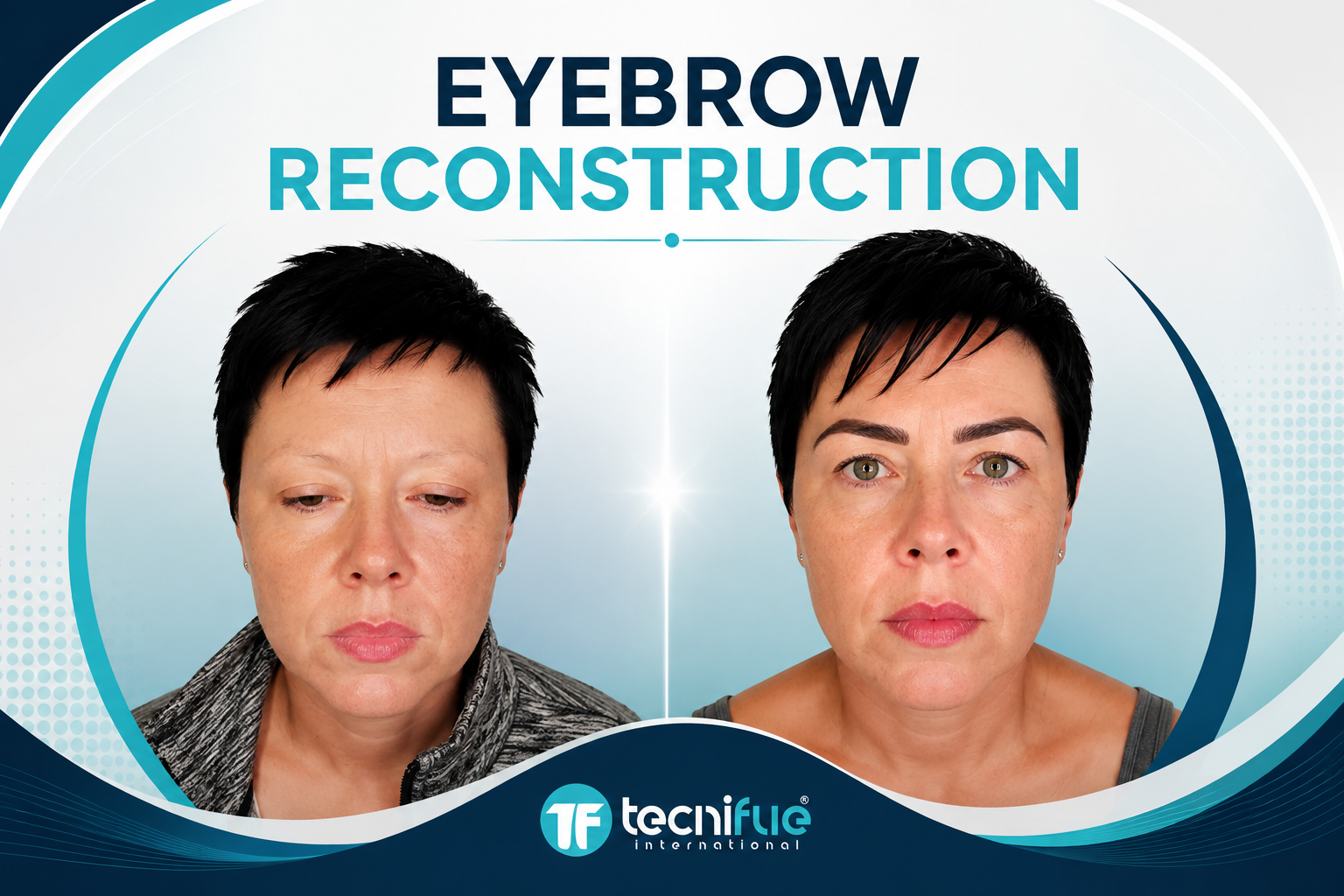

Quick Answer: Eyebrow reconstruction is a medical hair restoration procedure that rebuilds partially or completely missing eyebrows caused by scarring, burns, alopecia, trauma or chemotherapy. Unlike a standard cosmetic eyebrow transplant, it involves implanting follicular unit grafts into compromised or scarred skin, often after assessing blood supply and scar quality. Graft survival in scar tissue is typically lower than in healthy skin, and reconstruction may require staged sessions and a surgeon experienced with damaged tissue.
Key Takeaways
- Eyebrow reconstruction is medical, not purely cosmetic: it addresses brow loss from scarring alopecia, burns, trauma, radiation and chemotherapy rather than simple thinning or over-plucking.
- Scar tissue can support new hair grafts in most cases, but only after the scar has matured (usually 12+ months) and blood supply has been evaluated.
- Graft survival is lower in scarred skin than in healthy skin, which is why many reconstruction cases are planned in 2 stages rather than 1.
- Techniques range from FUE grafting to flap surgery, sometimes combined with micropigmentation for density; the right method depends on scar depth and size.
- Results are permanent because transplanted follicles come from your own scalp, but hairs keep growing and need trimming roughly once a week.
- Surgeon experience with scar tissue is the single biggest variable in outcome quality; ask specifically for scar-case before-and-after photos before booking.
Losing part or all of an eyebrow changes how a face reads. Brows frame expression, and a scarred or missing brow draws the eye in a way that thinning scalp hair rarely does. The good news: modern eyebrow reconstruction can restore natural-looking brows even on burn scars, surgical scars and skin affected by alopecia, provided the case is planned correctly.
This guide covers what eyebrow reconstruction involves, who qualifies, how it differs from a standard cosmetic transplant, realistic graft survival rates in scar tissue, and how to choose a clinic for complex cases.
What Is Eyebrow Reconstruction and Who Needs It
Eyebrow reconstruction is the surgical restoration of eyebrows that have been lost to injury, disease or medical treatment, using the patient’s own hair follicles or, in severe cases, tissue flaps. It differs from cosmetic brow enhancement because it must first solve a tissue problem (scar, poor blood supply, absent follicles) before it can solve an aesthetic one.
Reconstruction vs. Cosmetic Eyebrow Enhancement
The distinction comes down to the starting condition of the skin. A cosmetic eyebrow transplant places grafts into healthy skin to add density or improve shape. Reconstruction places grafts into damaged, scarred or follicle-free skin, which demands different planning, lower graft density per pass and sometimes preparatory treatment of the scar itself.
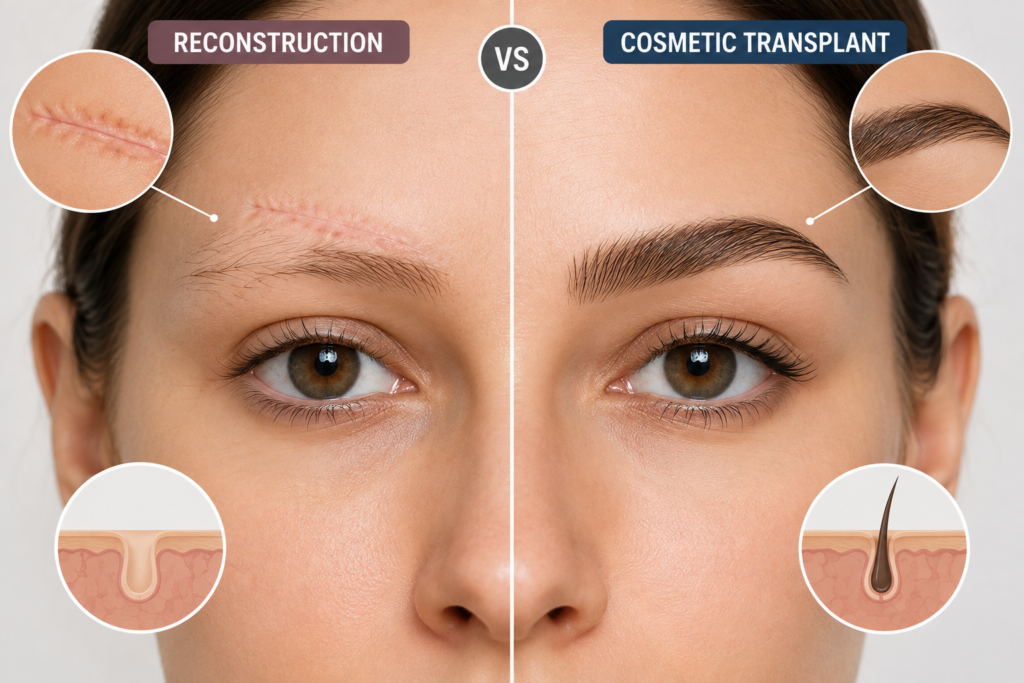
If your brow loss comes from over-plucking or natural thinning and the skin underneath is healthy, you likely need a standard eyebrow transplant in Turkey rather than full reconstruction. The procedure is simpler, cheaper and heals faster.
Common Causes That Lead Patients to Reconstruction
The most frequent reasons patients seek medical eyebrow reconstruction include:
- Scarring (cicatricial) alopecia that destroys follicles and leaves fibrous tissue
- Burn scars on the brow area, one of the most technically demanding scenarios
- Trauma scars from accidents, lacerations or dog bites crossing the brow line
- Post-surgical loss after tumor excision, forehead surgery or radiation therapy
- Chemotherapy-related loss where brows fail to regrow fully after treatment ends
- Alopecia areata or alopecia universalis, where autoimmune activity removes brow hair
- Chronic over-plucking or traction, which can permanently damage follicles over decades
Causes of Eyebrow Loss That Require Reconstruction
Not every cause of brow loss behaves the same way surgically. Understanding the underlying cause is the first step in planning, because it determines both timing and technique.
Scarring Alopecia and Autoimmune Conditions
Autoimmune-driven brow loss requires disease stability before any surgery. In scarring alopecias such as frontal fibrosing alopecia, the immune process destroys follicles and can attack newly transplanted grafts too. Most surgeons want the condition quiet, typically confirmed by a dermatologist, for at least 1-2 years before attempting eyebrow reconstruction after alopecia areata or a scarring alopecia.
With alopecia universalis, there is an added complication: the donor scalp hair may also be absent or unstable. Brow reconstruction after alopecia is only viable when a stable donor zone exists, which is why candid candidacy screening matters more here than in almost any other case type.
Burn and Accident Scars
Eyebrow reconstruction for burn scars is possible but depends heavily on scar depth and vascularity. Superficial burns that spared the deeper dermis usually accept follicular grafts well. Deep, full-thickness burn scars with pale, tight, shiny tissue have reduced blood supply, and grafts placed into them survive at lower rates. In severe cases surgeons stage the work: a first pass of grafts at reduced density, then a second session 8-12 months later once the first grafts have improved local circulation.
Trauma scars from accidents tend to be linear and narrower than burns, which makes eyebrow reconstruction for trauma scars one of the more predictable scenarios. A well-healed laceration scar crossing the brow can often be camouflaged fully in a single session.
Post-Surgical and Radiation-Related Loss
Radiated tissue heals differently and needs extra caution. Radiation therapy reduces skin vascularity long-term, so graft survival expectations should be set conservatively and testing a small area first is a reasonable strategy. Post-surgical scars (for example after skin cancer excision near the brow) generally behave like trauma scars once fully matured, usually after 12 months.
One practical note that many patients miss: a scar that is still pink, raised or itchy is still remodeling. Operating on it early wastes grafts.
Eyebrow Reconstruction Techniques Explained
Three main approaches cover nearly all reconstruction cases: follicular unit extraction (FUE) grafting, flap or graft-based surgery, and hybrid approaches that add micropigmentation. Most patients in 2026 are treated with FUE, with flaps reserved for severe tissue loss.
Follicular Unit Extraction on Scarred Tissue
FUE is the workhorse of modern brow reconstruction. Individual follicular units (mostly single-hair grafts for brows) are extracted from the scalp, usually behind the ears where hair caliber best matches natural brow hair, and implanted into the scar at precise angles. Brow hair grows nearly flat against the skin at angles of roughly 10-15 degrees, and recreating that angle in stiff scar tissue is the core technical challenge.
Key adaptations for scarred skin include:
1. Lower initial density, often 30-50% fewer grafts per square centimeter than in healthy skin, so each graft competes less for limited blood supply
2. Single-hair grafts almost exclusively, to mimic natural brow texture
3. Staged sessions, with a second pass after 8-12 months if density needs building
4. Careful depth control, since scar tissue thickness varies across the same scar
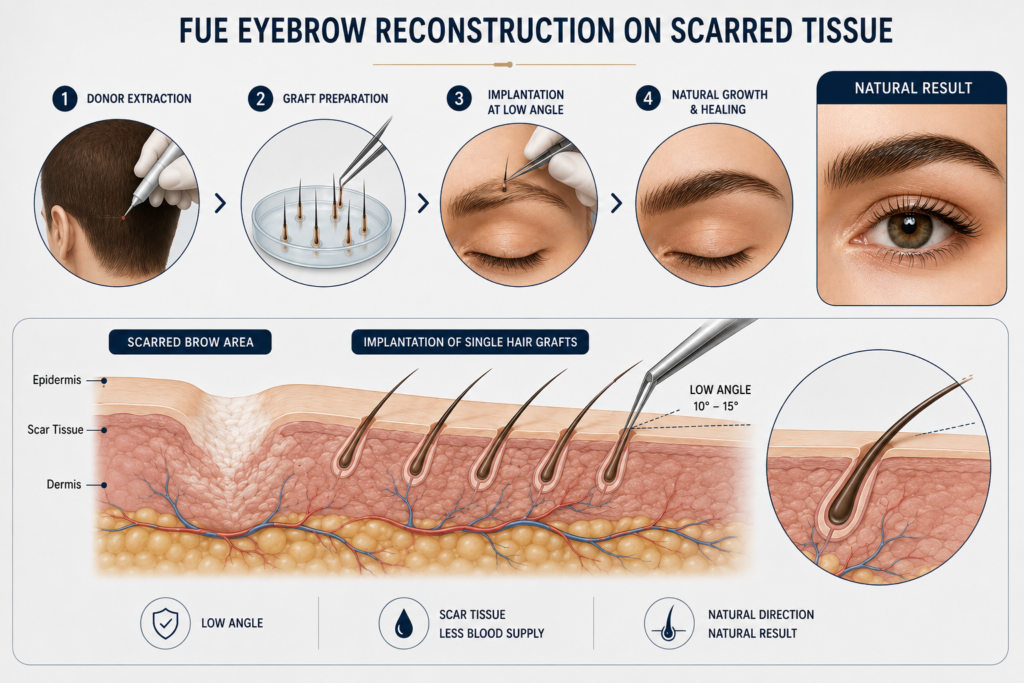
A typical full reconstruction uses between 50 and 400 grafts per brow depending on how much of the brow is missing. Severe burn cases sit at the high end and often need two sessions.
Flap and Graft-Based Reconstruction
Flap surgery is reserved for cases where grafting alone cannot work. When the brow region has lost not just hair but significant tissue (deep burns, tumor resection), a surgeon may rotate a strip of hair-bearing scalp, with its blood supply intact, into the brow position. Flap surgery for the eyebrow produces reliable coverage but often yields hair that grows faster and denser than a natural brow, requiring regular trimming and sometimes later refinement with FUE.
Composite grafts (small full-thickness pieces of hair-bearing scalp) are an older alternative, less used today because FUE gives finer control over angle and density.
Where a scalp scar is the donor concern rather than the recipient site, techniques like trichophytic closure (which allows hair to grow through the donor scar line) help keep the back of the head discreet. If donor scarring worries you, it is worth reading how FUE donor area scars actually look once healed; with brow cases the graft counts are small enough that donor marks are rarely visible even with short haircuts.
Combining Reconstruction with Micropigmentation
Micropigmentation fills the gap between what surgery achieves and what the eye expects. On wide or pale scars, a shading layer of medical micropigmentation behind transplanted hairs adds the illusion of underlying density without more grafts. This hybrid approach is common in burn reconstruction, where achieving full natural density with grafts alone may take three sessions but grafts plus pigment can look complete after one or two.
Micropigmentation alone, without grafts, remains an option for patients who are not surgical candidates. It fades over 2-4 years and does not move or catch light like real hair, but it is non-invasive.
Candidacy: Can Scar Tissue Support New Grafts?
In most cases, yes: mature scar tissue with adequate blood supply can support transplanted follicles, though at reduced survival rates compared with healthy skin. Candidacy assessment for scarred brow tissue is the step that separates good outcomes from disappointing ones.
Assessing Blood Supply and Scar Quality
Surgeons evaluate four practical markers before approving reconstruction:
- Scar maturity: at least 12 months old, no longer pink or actively remodeling
- Capillary refill: pressing the scar and watching color return indicates vascularity
- Scar pliability: soft, mobile scars accept grafts far better than rigid, adherent ones
- Scar thickness: very thin (atrophic) scars may be too shallow to anchor follicles; very thick (hypertrophic or keloid) scars carry their own risks
Some clinics perform a small test session of 10-20 grafts in questionable tissue and review survival at 6 months before committing to a full procedure. It slows the timeline but protects your donor supply, which is finite.
When Reconstruction Isn’t Recommended Yet
Timing failures cause more poor results than technique failures. Reconstruction is usually postponed or declined when:
- The scar is younger than 12 months
- An autoimmune condition (alopecia areata, frontal fibrosing alopecia) is still active
- Chemotherapy ended recently and natural regrowth hasn’t been given 6-12 months to declare itself
- The patient has a history of keloid formation on facial skin
- Radiated tissue shows poor healing signs
For eyebrow reconstruction after chemotherapy specifically, most surgeons advise waiting at least 6-12 months after the final treatment cycle. Many patients regrow substantial brow hair naturally in that window, and operating too early risks transplanting into brows that would have recovered anyway.
The Reconstruction Process Step by Step
A single reconstruction session takes roughly 2-4 hours under local anesthesia, and most patients fly home within 2-3 days. Here is how the process typically unfolds at an experienced clinic.
Consultation and Scar Evaluation
Everything starts with photographs and history. Expect questions about how the loss happened, when the scar formed, prior treatments, autoimmune status and medications. International clinics generally run this stage remotely: photo review, video consultation and a preliminary graft estimate, followed by an in-person scar assessment on arrival. Reputable providers will tell you at this stage if you are not yet a candidate. Treat that honesty as a green flag, not an inconvenience.
Procedure Day: Anesthesia and Graft Placement
The procedure itself is done under local anesthesia and is generally well tolerated. The sequence:
1. Design: the surgeon draws the brow shape with you sitting upright, matching your bone structure and any remaining brow hair
2. Extraction: follicular units are removed from the donor zone with a micro-punch (typically 0.7-0.9 mm)
3. Graft preparation: technicians sort single-hair grafts under magnification
4. Implantation: the surgeon creates recipient sites in the scar at flat, brow-appropriate angles and places each graft individually
For scar cases, ask directly who creates the recipient sites. Angle and depth decisions inside scar tissue are the surgeon-level part of the work, and it is a fair and normal question for any clinic, in Turkey or the US.
Healing Timeline for Scarred Skin
Healing on scarred skin runs slightly slower than the standard timeline, but the overall arc is similar:
- Days 1-7: small crusts around each graft; no rubbing, no makeup on the area
- Days 7-14: crusts shed; redness fades (scarred skin may stay pink 1-2 weeks longer than healthy skin)
- Weeks 2-8: transplanted hairs shed. This is normal and expected, not graft failure
- Months 3-5: new growth begins
- Months 8-12: full result; a second-stage session, if needed, is planned around month 10-12
Most patients are socially presentable within 7-10 days and back at a desk within 2-3 days. The day-by-day experience closely mirrors a standard FUE recovery timeline, just concentrated on a much smaller area.
Results, Risks, and Realistic Expectations
Reconstruction can look remarkably natural, but expectations must be calibrated to the tissue you start with. This is where honest clinics differ most from sales-driven ones.
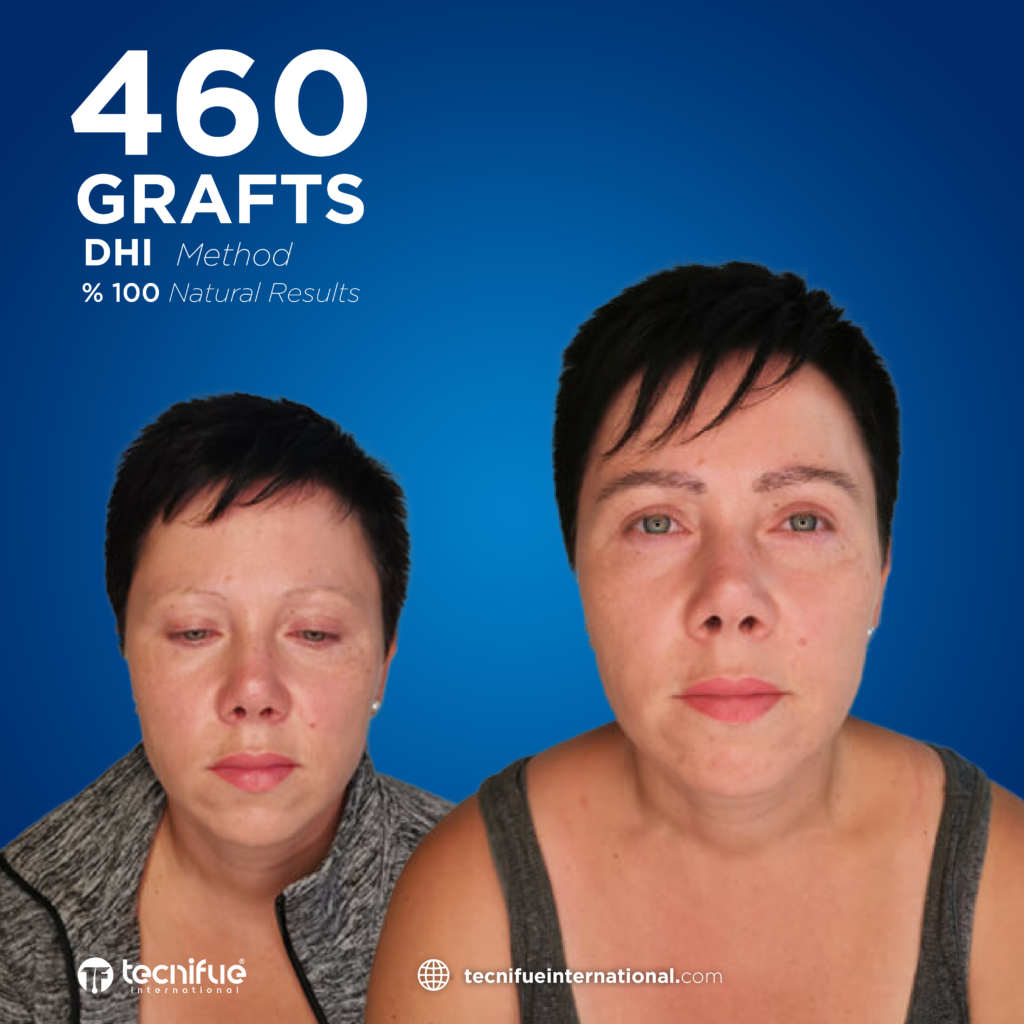
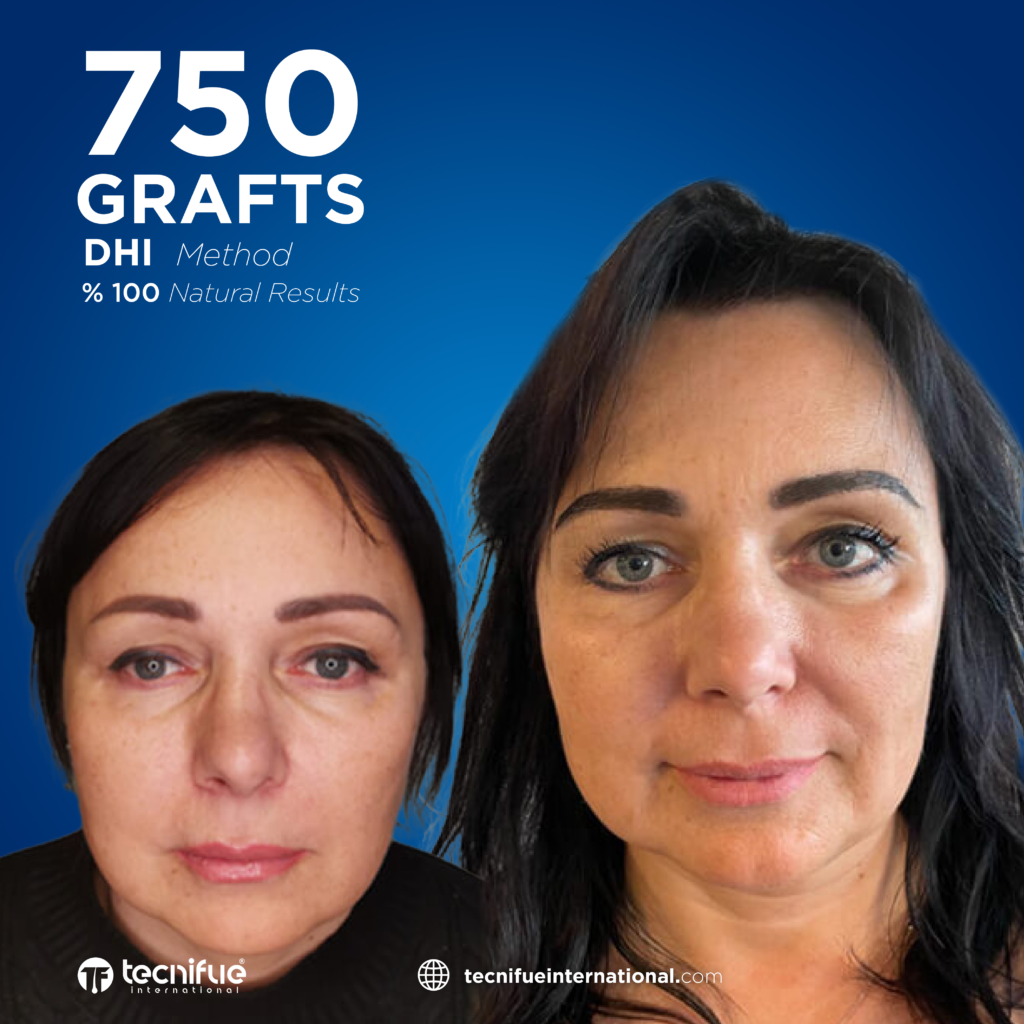
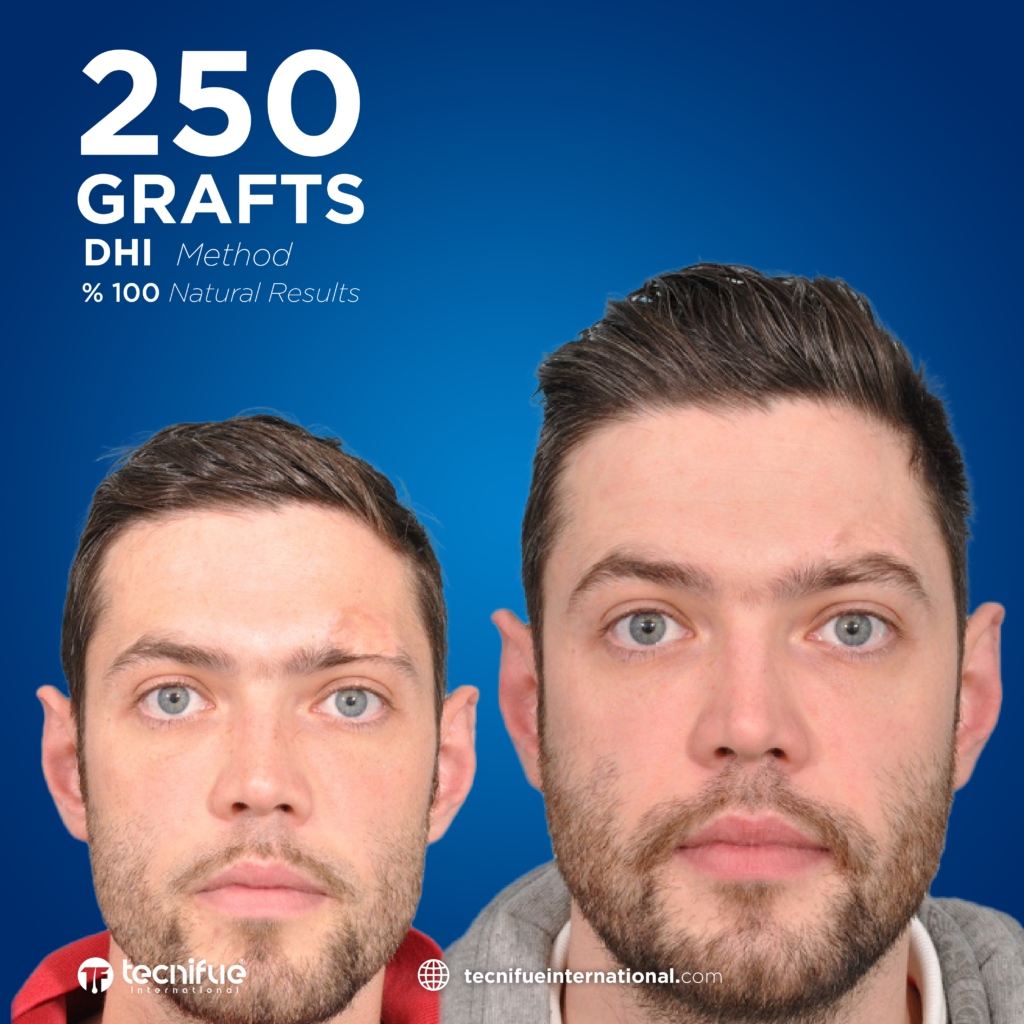
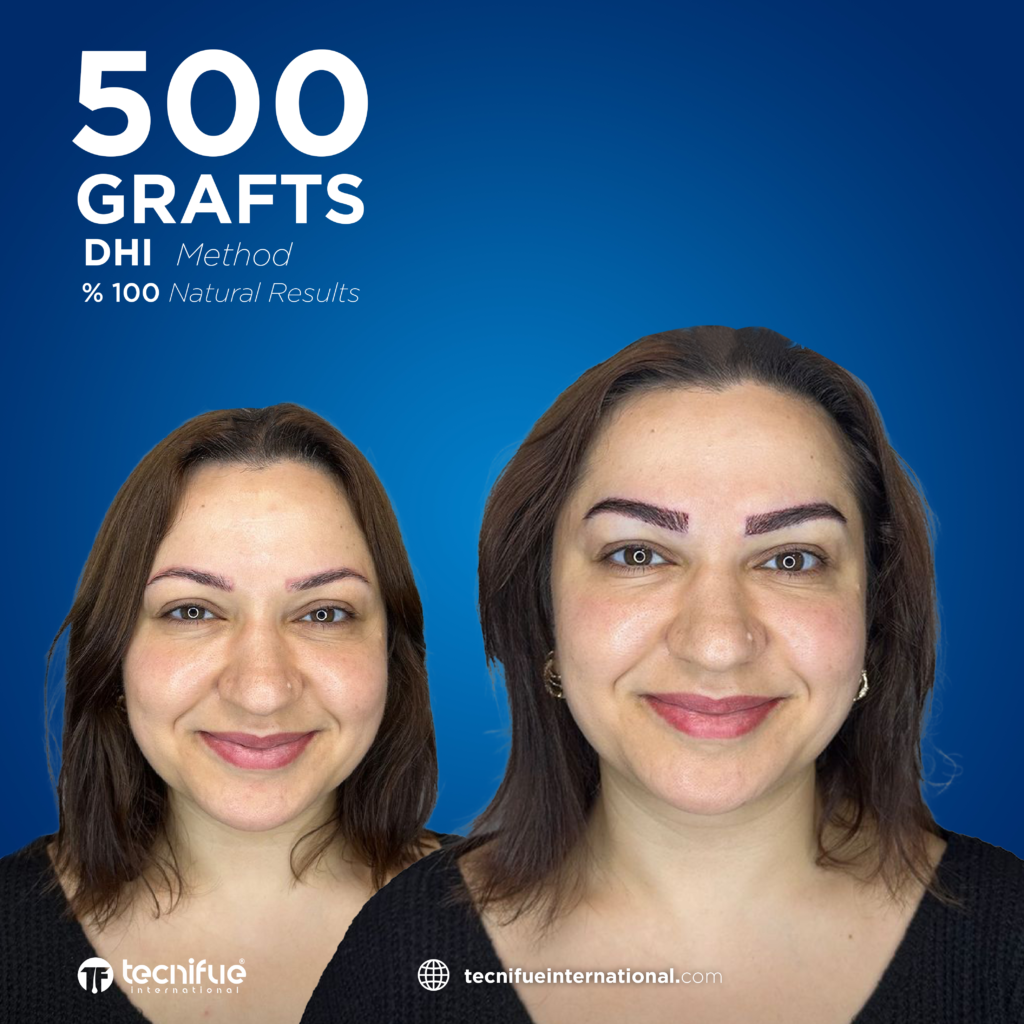
Graft Survival Rates in Scar Tissue vs. Healthy Skin
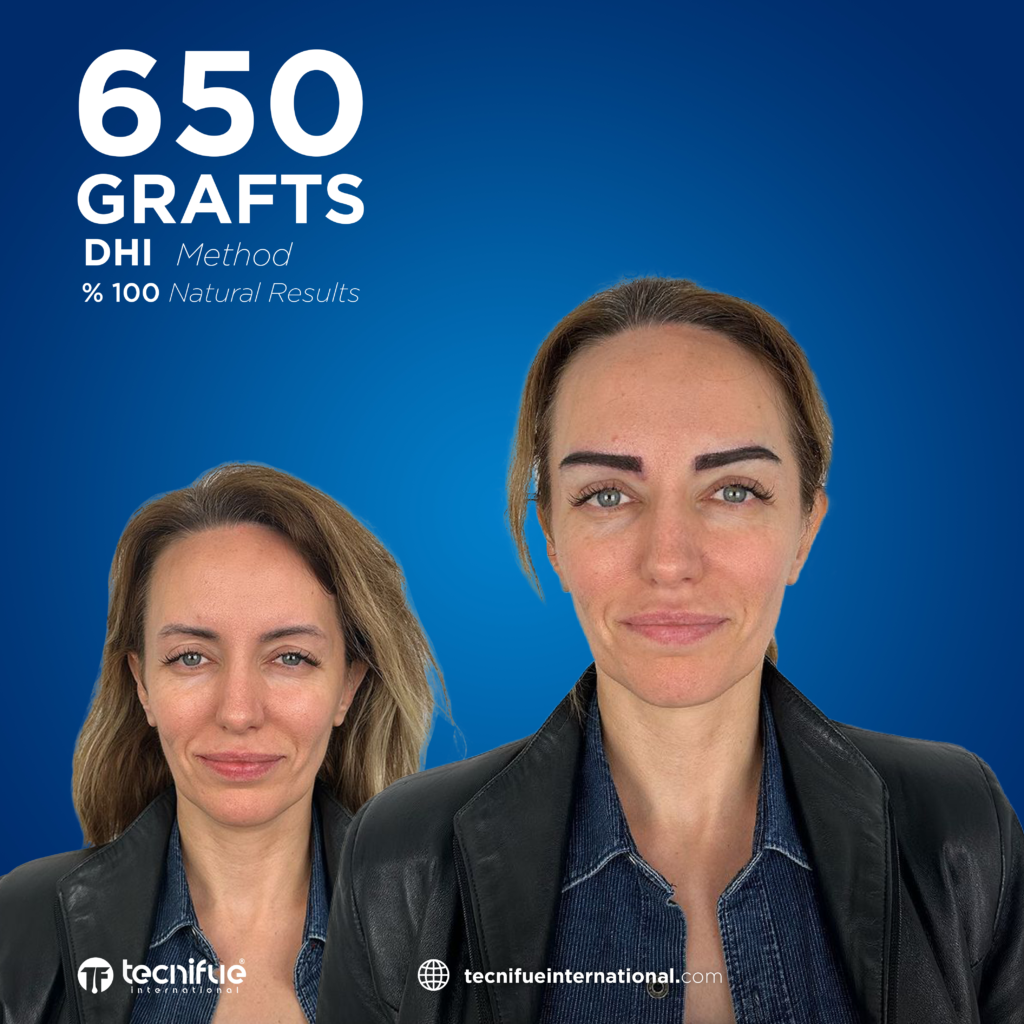
Graft survival is generally higher in healthy skin than in scarred skin, though exact rates vary from patient to patient and depend heavily on scar quality and vascularity. Deeply fibrotic or radiated tissue tends to perform worst. Because specific survival percentages differ by case and are not something any clinic can guarantee, ask your surgeon what range they realistically expect for your particular scar rather than relying on general figures. Practically, this means a reconstruction patient should expect either slightly lower final density from one session or a planned two-session approach.
Natural Density and Growth Direction Challenges
Direction matters more than density in brows. A natural eyebrow has a precise flow: upward at the head, gradually angling outward and downward toward the tail, with hairs lying nearly flat. Scar tissue resists the flat implantation angles this requires, and a reconstruction that gets density right but direction wrong still looks off. When reviewing eyebrow transplant before and after photos, look specifically at hair flow in close-up images, not just fullness at a distance.
Transplanted hairs also retain scalp-hair behavior: they keep growing and need trimming about once a week, indefinitely. Most patients consider this a minor trade-off; a few find it annoying. Know it going in.
Potential Complications on Scar Tissue
Complications are uncommon but real, and scarred skin raises the baseline risk slightly:
- Lower-than-expected graft take in poorly vascularized areas
- Cyst formation or ingrown hairs, more frequent in stiff tissue
- Prolonged redness over the scar
- Visible mismatch between transplanted and native hair if design was rushed
- Rarely, scar worsening in keloid-prone patients
Most of the “eyebrow transplant gone wrong” cases circulating online trace back to two errors: wrong angles placed by inexperienced hands, or grafting into tissue that was never properly assessed. Both are avoidable with clinic selection.
Eyebrow Reconstruction vs. Standard Eyebrow Transplant
These are related procedures with different complexity levels, and the differences affect cost, timeline and clinic choice. The comparison below is the fastest way to see where your case sits.
| Factor | Eyebrow Reconstruction | Cosmetic Eyebrow Transplant |
| Typical cause | Burns, trauma scars, scarring alopecia, chemo/radiation, surgery | Over-plucking, natural thinning, shape improvement |
| Recipient skin | Scarred or damaged tissue, reduced blood supply | Healthy skin with normal vascularity |
| Technique | FUE at reduced density, staged sessions, sometimes flaps or micropigmentation | Single-session FUE at standard density |
| Graft survival | Lower and more variable in scar tissue | Higher in healthy skin |
| Sessions needed | Often 1-2 (occasionally 3 for severe burns) | Usually 1 |
| Candidacy screening | Extensive: scar maturity, vascularity, disease stability | Straightforward |
| Healing | 8-12 months to final result; redness may last longer | 8-12 months to final result; faster early healing |
| Cost | Higher per case due to complexity and possible staging | Lower; standard package pricing |
Cost and Timeline Comparison
Geography drives cost more than technique does. In the US, eyebrow procedures commonly run $3,000-$8,000 per session, with complex reconstruction cases at the top of that range or above; eyebrow transplant cost in major metros like NYC skews higher still. In Turkey, the same work is typically 50-70% less, largely due to lower operating costs rather than lower standards, which is the same economics behind the broader question of why Turkey leads hair transplantsglobally.
For patients comparing an eyebrow transplant near home against traveling: factor in that reconstruction may need two trips if staged, and price the total accordingly. A clinic that quotes one session for a deep burn scar without examining you deserves skepticism.
Choosing a Clinic for Complex Brow Reconstruction Cases
Experience with scar tissue is the deciding factor, above price and above location. A surgeon who has done hundreds of cosmetic brow transplants but few scar cases is not automatically equipped for a burn reconstruction.
Questions to Ask Before Booking
Put these to any clinic, whether in the US, Europe or Istanbul:
1. How many brow reconstruction cases on scar tissue have you performed, and can I see before-and-after photos of cases like mine?
2. Who performs extraction and who creates recipient sites: the surgeon or technicians?
3. Do you stage complex cases, and is a possible second session priced into my quote?
4. What is your policy if graft survival is poor: revision terms, costs, remote follow-up?
5. How do you assess scar vascularity before committing to a graft count?
6. What does the package actually include (accommodation, transfers, aftercare kit, medications), and what costs extra?
Clear written answers to questions 3 and 4 matter most for international patients. A defined revision policy and structured remote follow-up (photo reviews at 1, 4, 8 and 12 months are a reasonable standard) solve the “what if something goes wrong when I’m home” concern better than any verbal reassurance.
Why Experience with Scar Tissue Matters
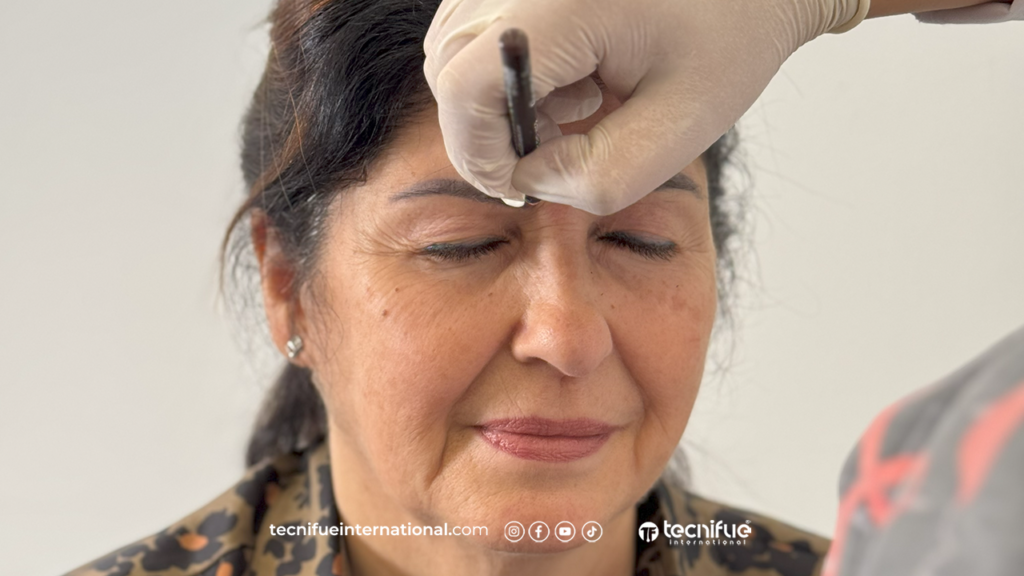
Scar cases punish improvisation. Depth control, angle creation in rigid tissue, density judgment against limited blood supply: these are learned across many reconstruction cases, not transferred automatically from scalp work. Clinics such as Tecnifue International in Istanbul that handle both routine and reconstructive brow transplant cases can show you the difference in their own galleries; ask specifically for scar-case results rather than the standard cosmetic portfolio, and expect verifiable photos, not composites.
One more filter that costs nothing: read independent patient reviews on platforms the clinic doesn’t control (Trustpilot, Google, Reddit threads on eyebrow transplants). Patterns across dozens of reviews tell you more than any single testimonial.
Frequently Asked Questions
Can you regrow eyebrows after scarring without surgery?
Usually not. Scar tissue lacks hair follicles, so no serum, oil or growth product can produce hair where follicles no longer exist. Topicals like minoxidil may help thin-but-present brows, but true scarred areas need transplanted follicles or micropigmentation to appear restored.
Is eyebrow reconstruction permanent?
Yes. Transplanted follicles come from your own scalp and continue producing hair for life once established. The hairs retain scalp characteristics, so they grow longer than native brow hair and need trimming roughly weekly. Micropigmentation, by contrast, fades within 2-4 years.
How much does eyebrow grafting cost?
In the US, expect roughly $3,000-$8,000 per session depending on graft count and city, with complex scar reconstruction at the higher end. In Turkey, comparable procedures typically cost 50-70% less, often as all-inclusive packages covering accommodation and transfers. Staged reconstruction cases should be priced as a total across sessions, not per trip.
What is the newest eyebrow procedure?
The most significant recent development is not a single new device but refined hybrid protocols: single-hair FUE implanted with implanter pens for flatter angles, combined with medical micropigmentation for underlying density on scars. Implanter-pen (DHI-style) placement has become the preferred approach for brow work because it gives finer angle control in tight tissue.
What are the downsides of eyebrow transplants?
The main drawbacks: transplanted hairs need lifelong weekly trimming, final results take 8-12 months, density in scar tissue may need a second session, and poorly angled grafts are difficult to correct. Most regret cases stem from bad design or inexperienced placement rather than the procedure concept itself, which is why surgeon selection matters more than price.
Who is a candidate for eyebrow reconstruction?
Good candidates have a mature scar (12+ months old), stable underlying condition (autoimmune disease quiet for 1-2 years, chemotherapy finished 6-12 months prior), adequate donor hair on the scalp, and realistic expectations about staged treatment. Active keloid formers and patients with heavily radiated, poorly vascularized tissue may be advised against surgery or toward micropigmentation instead.
—
*This article is for educational purposes only and does not replace personalized medical advice. Consult a qualified physician or hair restoration surgeon to evaluate your individual case.*