

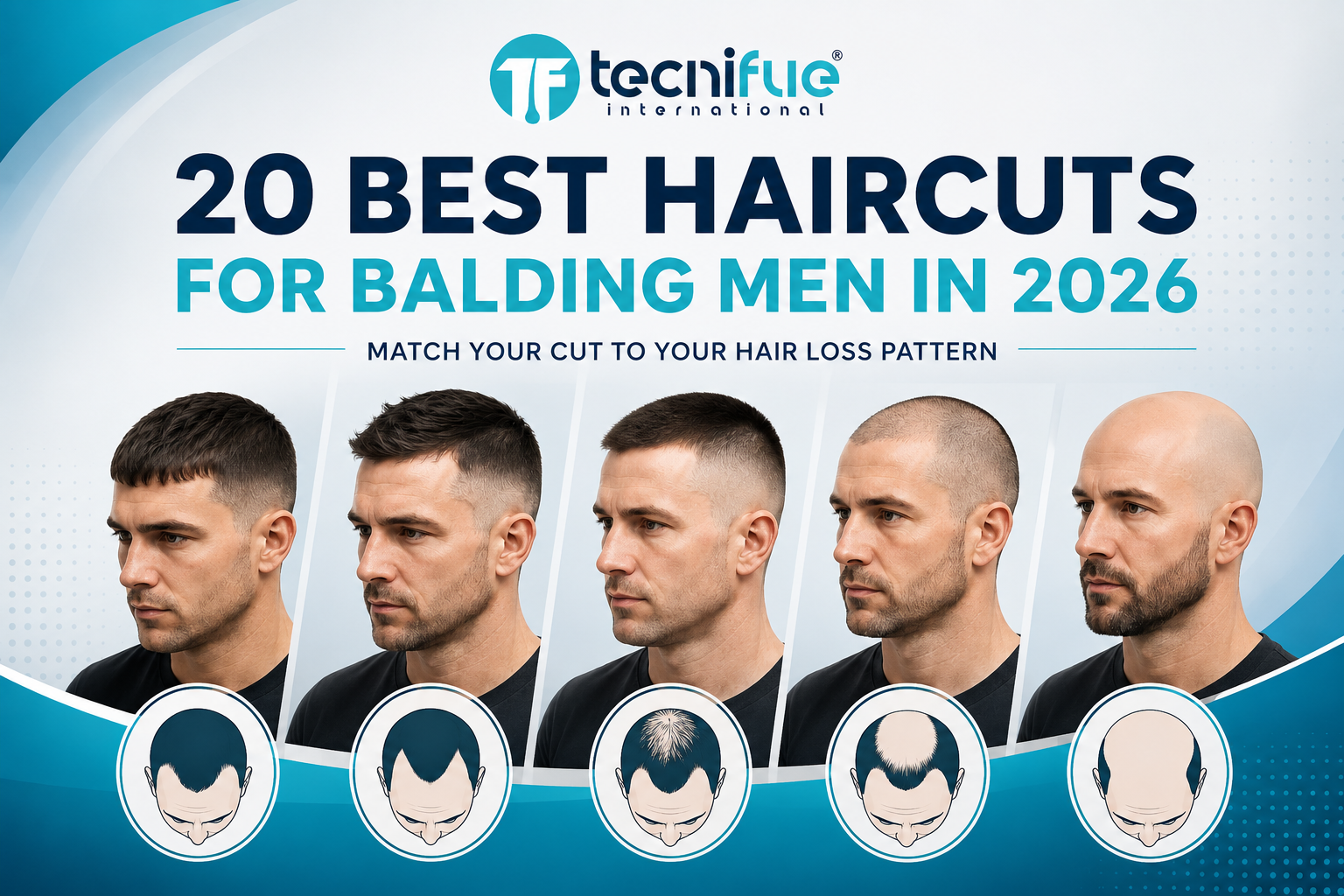

Quick Answer: The best haircuts for balding men keep the overall length short and add texture, which minimizes the contrast between thick and thin areas. Top choices in 2026 are the buzz cut, crew cut, Caesar cut, textured crop, and high and tight, matched to your specific hair loss pattern (receding hairline, thinning crown, or diffuse thinning). Going shorter almost always looks more intentional and confident than trying to cover thinning hair with longer strands.Reviewed by Mrs Ayse Cagla Hair Transplant Specialist at TecniFUE International.
Key Takeaways
- Shorter is stronger: cuts between 1mm and 20mm (buzz cut to crew cut range) reduce the visible contrast between dense and thinning zones better than any cover-up style.
- Match the cut to the pattern: a receding hairline calls for a Caesar cut or textured crop, a thinning crown suits a high and tight or skin fade, and diffuse thinning favors an even buzz cut.
- Texture fakes fullness: matte products and choppy, forward-styled layers can make thinning hair look noticeably denser to the eye without adding a single hair.
- Avoid comb-overs and long floppy styles: anything that relies on covering a bald spot fails the moment wind, sweat, or gravity gets involved.
- A beard rebalances the face: pairing a short cut with facial hair shifts visual weight downward and is one of the most effective free upgrades for men going bald.
- Know when styling stops working: once loss reaches roughly Norwood 4-5, haircuts manage appearance but no longer hide it; that is the point where many men start researching restoration options.
Losing your hair does not mean losing your style options. It means the rules change. This guide covers 20 barber-approved haircuts for balding men, organized by hair loss pattern, plus the styles to avoid, the products that make thinning hair look fuller, and an honest section on what to do when a haircut alone no longer cuts it.
Why the Right Haircut Matters When You’re Balding
The right haircut can make you look significantly younger and more put-together, while the wrong one draws a spotlight to exactly what you want to minimize. Male pattern baldness is very common and becomes more prevalent with age, so barbers have decades of collective experience solving this exact problem. The core principle never changes: reduce contrast, add texture, own the look.
How hair loss patterns (the Norwood scale) affect haircut choice
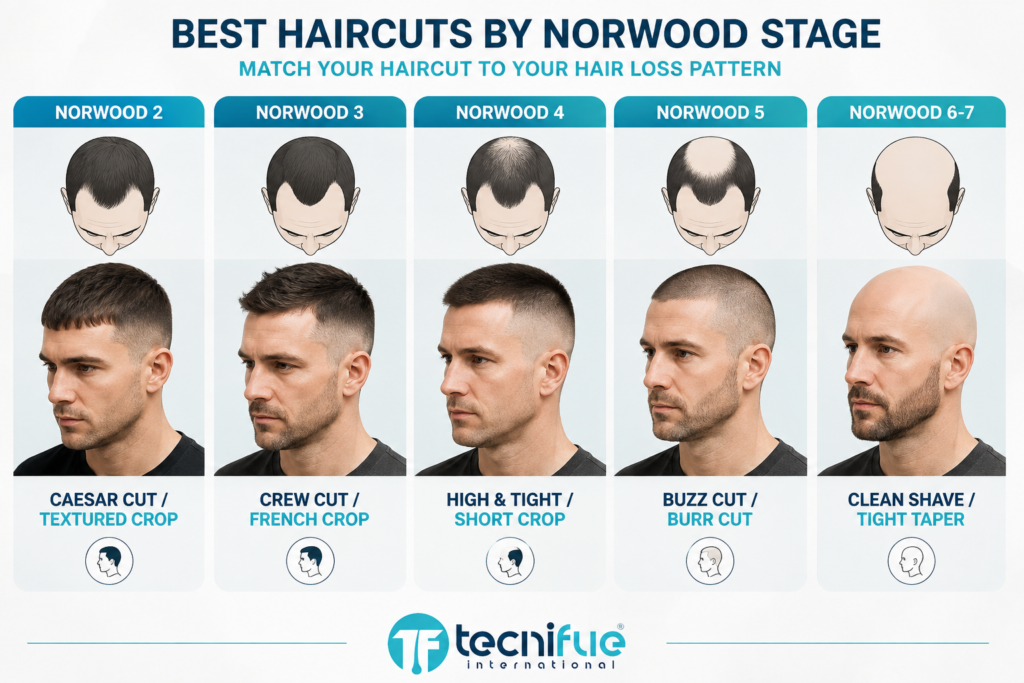
Your Norwood stage, not your face shape, is the first filter for choosing a haircut. The Norwood scale is the standard classification for male pattern baldness, running from stage 1 (no visible loss) to stage 7 (only a horseshoe of hair remaining). Male pattern baldness hairstyles work when they respect where you actually are on that scale:
- Norwood 2-3 (receding temples, early widow’s peak): you still have plenty of density on top, so forward-styled cuts like the Caesar or textured crop work brilliantly.
- Norwood 3 vertex to 4 (thinning crown appears): shorter backs and crowns matter now; think crew cut, high and tight, or a skin fade that blends the thin crown into the cut.
- Norwood 5-6 (bridge between hairline and crown breaks down): buzz cuts, stubble-length crops, or a full shave read as deliberate choices rather than damage control.
The confidence factor is real, not vanity
A well-matched haircut changes how you carry yourself in meetings, on video calls, and in photos. Most men going bald report that the anxiety comes less from the hair loss itself and more from feeling like it looks unmanaged. A sharp, intentional cut removes that variable entirely. Barbers consistently see the same reaction: the man who finally buzzes down after months of comb-over anxiety walks out standing straighter.
20 Best Haircuts for Balding Men in 2026
The best haircuts for balding men in 2026 fall into six families: skin-close crops, classic short cuts, textured styles, swept styles, military-inspired cuts, and contrast cuts with faded sides. Here are all 20, with who each one suits best.
Comparison table: haircut vs. hair loss pattern
| # | Haircut | Best For | Hair Loss Pattern | Maintenance |
|---|---|---|---|---|
| 1 | Buzz cut (induction) | Evening out all thinning | Diffuse, Norwood 4-6 | Very low |
| 2 | Buzz cut with beard | Rebalancing facial proportions | Any pattern | Low |
| 3 | Clean shave | Advanced loss, bold statement | Norwood 6-7 | Medium (regular shaving) |
| 4 | Stubble-length shave | Softer version of full shave | Norwood 5-7 | Low |
| 5 | Crew cut | Early recession with density on top | Norwood 2-3 | Low |
| 6 | Caesar cut | Hiding a receding hairline | Receding temples | Low |
| 7 | Ivy League | Professional settings, early loss | Norwood 2-3 | Medium |
| 8 | Textured crop | Faking fullness with layers | Diffuse thinning on top | Medium |
| 9 | Messy fringe | Softening a high forehead | Receding hairline | Medium |
| 10 | French crop with fade | Modern, sharp, forward-styled | Receding hairline | Medium |
| 11 | High and tight | Crown thinning | Balding crown | Low |
| 12 | Skin fade with short top | Blending thin areas seamlessly | Crown + temples | Medium-high (frequent trims) |
| 13 | Burr cut (2-4mm) | Between buzz and shave | Norwood 5-6 | Very low |
| 14 | Slick back (short) | Fine but even hair | Early diffuse thinning | Medium |
| 15 | Side part with taper | Conservative, office-friendly | Norwood 2-3 | Medium |
| 16 | Short pompadour | Height that distracts from temples | Early recession | High |
| 17 | Long-on-top, faded sides | Maximum contrast styling | Norwood 2-3 only | High |
| 18 | Faux hawk / textured spikes | Directing eyes to the center | Receding temples | Medium |
| 19 | Widow’s peak feature cut | Making the V-point a signature | Widow’s peak recession | Low-medium |
| 20 | Horseshoe embrace (tight taper) | Advanced loss, no cover-up | Norwood 6-7 | Low |
Buzz cut and skin-close crops (#1-4)
The buzz cut for balding men is the single most recommended cut by barbers, and for good reason: clipping everything to one uniform length (typically 1.5-6mm) erases the contrast that makes thinning obvious. A buzz cut with a beard goes one step further by moving visual weight to the jawline. The clean shave and stubble-length shave belong in the same family; they answer the “should I just shave it” question with a confident yes for men at Norwood 5 and beyond.
One practical note barbers rarely say out loud: a buzz cut also reveals everything. Scalp texture, moles, and any scarring become visible at 2-3mm, which is worth knowing before you commit.
Crew cut and Caesar cut (#5-7)
The crew cut keeps 15-30mm on top with tapered sides, making it the best haircut for receding hairline cases in the early stages, when you still have workable density. The Caesar cut, with its short, straight, forward-combed fringe, is arguably the most underrated haircut for receding hairline men: the horizontal fringe line literally redraws your hairline 1-2cm lower than where recession has pushed it. The Ivy League is a slightly longer, side-parted crew cut that stays boardroom-appropriate.
Textured crop and messy fringe (#8-10)
The textured crop is the best hairstyle for thinning hair that still has moderate density, because choppy layers styled forward break up scalp visibility. A messy fringe softens a high or uneven hairline without looking styled-to-hide. The French crop with a fade sharpens the whole package for 2026’s cleaner aesthetic. All three rely on matte product, never gel, to keep strands separated and full-looking.
Slick back and side part styles (#14-16)
Swept styles only work while thinning is even and mild. A short slick back with a light matte paste suits fine hair that has not developed obvious gaps, and a classic side part with a taper remains the safest professional option at Norwood 2-3. The short pompadour adds vertical height that pulls eyes up and away from receding temples, but it demands daily styling and honest self-assessment: once the crown thins visibly, retire it.
High and tight and military-inspired cuts (#11-13)
The high and tight is the go-to haircut for balding crown cases: the back and sides are clipped very short and high, so the thinning crown merges into the cut instead of sitting above a band of longer hair that highlights it. The burr cut (2-4mm all over) is the military middle ground between a buzz and a shave. These are among the most effective fade haircuts for balding men on top because the fade does the blending work for you.
Long-on-top and contrast cuts (#17-20)
Can you still have long hair while balding? Honestly, only at Norwood 2-3 with good density on top. A long-on-top style with skin-faded sides creates deliberate contrast that reads as fashion, not concealment. The faux hawk directs attention to the center strip where most men keep density longest. A widow’s peak feature cut leans into the V-point instead of fighting it. And the tight horseshoe taper is the dignified endgame cut for Norwood 6-7: everything clipped to a uniform 1-3mm, no denial, all intention.
Best Haircuts by Hair Loss Pattern
Matching the cut to your specific pattern matters more than following any trend. Here is the shortlist by pattern, which doubles as a quick Norwood-to-haircut cheat sheet.
Receding hairline (temples and widow’s peak)
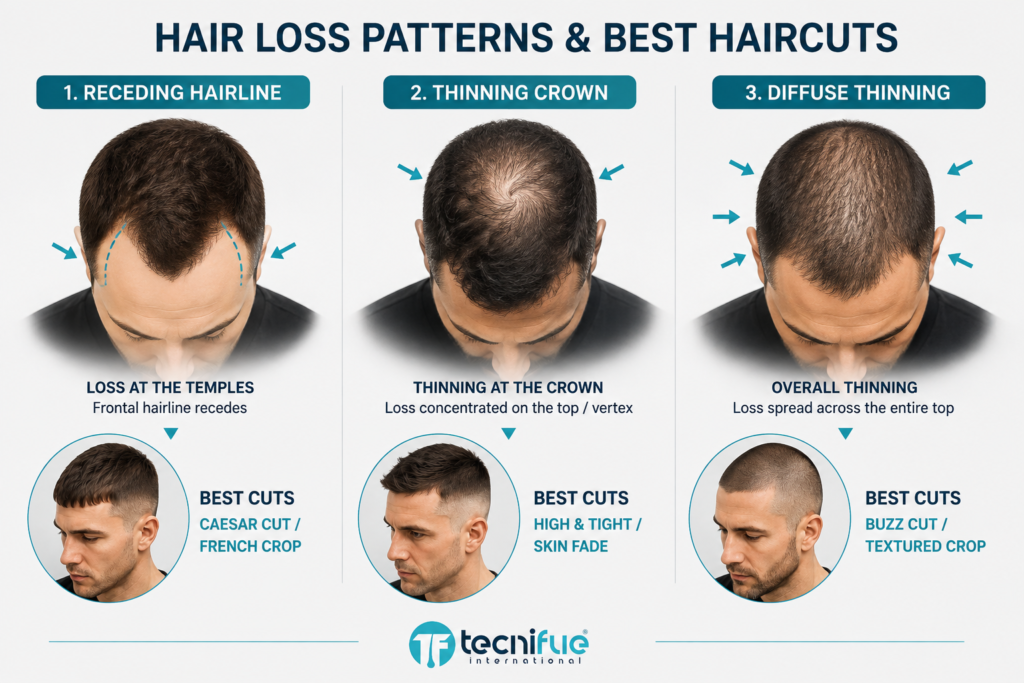
A Caesar cut, French crop, or messy fringe hides temple recession better than any other approach because forward-styled fringe physically covers the M-shaped hairline. Keep the fringe blunt and horizontal, ask your barber for “point cutting” to avoid a helmet look, and keep the sides tapered so the forward styling looks intentional.
Thinning crown and bald spot on top
For a haircut for bald spot on top, go high and tight or take a skin fade up past the crown line. Short haircuts for bald spot management work on one principle: when the hair around the spot is 3-6mm, a thinning crown becomes nearly invisible, but when surrounding hair is 30mm+, the spot looks like a hole. Haircuts for balding crown situations are the clearest case where shorter genuinely equals fuller-looking.
Diffuse thinning all over
An even buzz cut or textured crop with matte product handles diffuse thinning best, because there is no single spot to blend, just overall reduced density. Uniform length plus texturizing powder is the combination barbers reach for. This is also the pattern where a slightly longer slick back can still work if the thinning is early.
Combination pattern (Norwood 4-6)
At Norwood 4-6, where the hairline and crown thinning start to merge, the honest options narrow to the buzz cut, burr cut, stubble, or full shave. This is the range where short hairstyles for bald spot coverage and hairline styling stop being separate problems. Trying to keep length here is one of the most common styling mistakes barbers see, and it is also the stage where many men start seriously weighing restoration.
Haircuts to Avoid When You’re Balding
Any style built on covering rather than blending will eventually betray you, usually in public. Three categories to strike off the list:
- The comb-over. Sweeping long strands across a bald area fools nobody in person and fails completely on video calls, where overhead lighting shines straight through. It is one of the most frequently criticized style mistakes barbers point to.
- Long, floppy, or curtain styles. Length adds weight, weight flattens hair, and flat thin hair shows maximum scalp. Longer hair also frames gaps at the temples instead of hiding them.
- High-maintenance dense-hair styles. Full pompadours, heavy quiffs, and man buns require density you no longer have. A hairstyle to hide thinning hair should never take more than 2-3 minutes and one product; if it does, the style is working against your hair, not with it.
The old man haircut that is bald on top with long sides deserves its own mention: keeping length on the sides while the top goes creates the exact contrast every good cut on this list is designed to eliminate. Taper the sides down.
Styling Tips to Make Thinning Hair Look Fuller
Product choice and cut frequency do about half the work of the haircut itself. Four rules cover most of it:
- Go matte, always. Clays, pastes, and texturizing powders separate strands and scatter light. Gels and pomades clump hair and create shine that makes scalp show-through worse.
- Cut more often, not less. Thinning hair loses its shape faster. A trim every 2-3 weeks for short cuts (versus the typical 4-6 for thick hair) keeps the blend tight.
- Use volume tricks at the roots. Blow-dry short styles against the growth direction for 30 seconds before applying product. Sea salt spray on damp hair adds grip for fine strands.
- Grow the beard. Facial hair rebalances a face that is losing its upper frame. The buzz-plus-beard combination is consistently ranked among the most flattering pairings for men with advanced loss.
One thing most articles skip: wash frequency matters. Washing daily with harsh shampoo strips the natural texture fine hair needs to hold volume. Every other day, with a lightweight volumizing formula, is usually the better rhythm.
Photos: Balding Haircuts Done Right
Celebrity examples prove that embracing the pattern beats fighting it, at every stage of loss. Jason Statham’s stubble-length crop, Prince William’s tight taper, and Thierry Henry’s clean fade all follow the same playbook: short, even, intentional. Stanley Tucci’s full shave shows the Norwood 7 endgame handled with total confidence. For inspiration by pattern, a haircuts for balding men gallery works best when you filter by your own Norwood stage rather than by face shape, because a cut that flatters a Norwood 2 crown will not translate to a Norwood 5.
When a Haircut Isn’t Enough: Next Steps
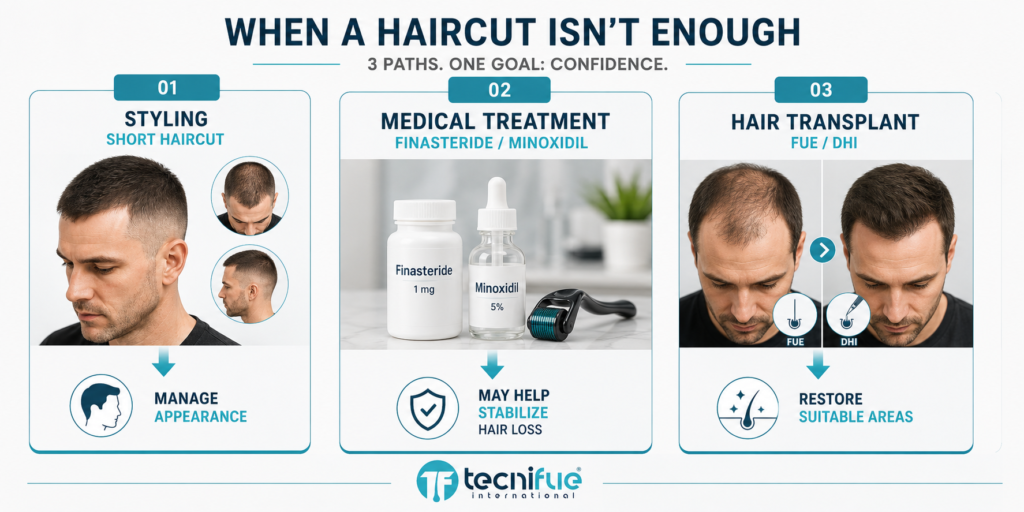
A haircut manages the appearance of hair loss; it cannot stop or reverse it. Two signals suggest styling has hit its limit: your barber is cutting shorter every visit just to maintain the same blended look, or the thinning zones have merged so no length setting hides the contrast. At that point, men typically face three paths.
Medication (such as finasteride or minoxidil) may slow or partially reverse loss for some men, though results vary; whether any medication is appropriate for you, and at what dose, should be decided only by a prescribing physician after evaluating your individual case. Acceptance via a buzz or shave is free, instant, and genuinely stylish. Hair restoration is a longer-term surgical route; modern FUE (follicular unit extraction) leaves no linear scar, which some men prefer if they want to keep wearing short cuts afterward. Whether any procedure is suitable for you is a medical decision that requires an in-person assessment by a qualified doctor.
Cost is another consideration. Prices for surgical hair restoration vary widely by country, clinic, and the number of grafts required, so any figure you see online should be treated as a rough starting point rather than a quote. Recovery timelines also vary by individual and technique. Because pricing, candidacy, and outcomes all depend on your specific situation, the responsible next step is a consultation with a licensed medical professional who can examine your donor density and hair loss pattern directly.
Am I too far gone at Norwood 5? Not necessarily, but this is exactly the kind of question that cannot be answered from an article. Candidacy depends on factors such as donor density at the back and sides rather than the size of the bald area alone, which is why a proper hair analysis by a qualified doctor should come before any decision or quote. If you are considering restoration, ask a medical professional to explain the differences between techniques and to show you documented outcomes for patients with a similar age and Norwood stage. Verifying a clinic’s before-and-after cases against comparable patients is a sensible precaution, but the medical judgment itself belongs to a licensed practitioner.
FAQs About Haircuts for Balding Men
What is the best haircut if you’re balding?
The buzz cut is the safest single answer because it works at every Norwood stage, but the best haircut depends on your pattern: a Caesar cut for a receding hairline, a high and tight for a thinning crown, and an even buzz for diffuse thinning. When in doubt, go one length shorter than feels comfortable.
Should balding men shave their head?
Shave only when clipped styles no longer blend, typically around Norwood 5-6. Before that stage, a buzz cut, burr cut, or crew cut preserves more styling flexibility. Shaving does not affect hair loss speed either way; it is purely a style decision, and at advanced stages it is usually the sharpest one available.
Does short hair make thinning hair less noticeable?
Yes, significantly. Thinning is visible because of the contrast between dense and sparse areas, and short, uniform lengths (roughly 3-20mm) minimize that contrast. Longer hair separates, flattens, and exposes scalp, which is why barbers almost universally advise cutting shorter as loss progresses.
How do I style my hair if I’m losing it?
Use a matte clay or texturizing powder on dry hair, style forward or up rather than flat, and keep total styling under 3 minutes. Blow-drying against the growth direction before product adds root volume. Avoid gels, heavy pomades, and anything shiny, since shine amplifies scalp show-through.
How often should balding men get a haircut?
Every 2-3 weeks for short cuts like fades, crops, and buzz cuts, versus 4-6 weeks for longer styles. Thinning hair loses its blended shape faster because the contrast between zones re-emerges as hair grows. Many men at buzz length simply maintain it at home weekly with clippers.
Can a barber recommend the best style for my hair loss stage?
Yes, and a good one will do it unprompted. Bring reference photos of men with a similar Norwood stage (not celebrities with transplants or dense hair), ask directly “what would you do with my pattern,” and be open to going shorter than you planned. Barbers see hundreds of balding heads a year; their pattern-matching instincts are usually excellent.
This article is for general informational purposes and does not replace personalized advice from a dermatologist or qualified medical professional regarding hair loss treatment.