

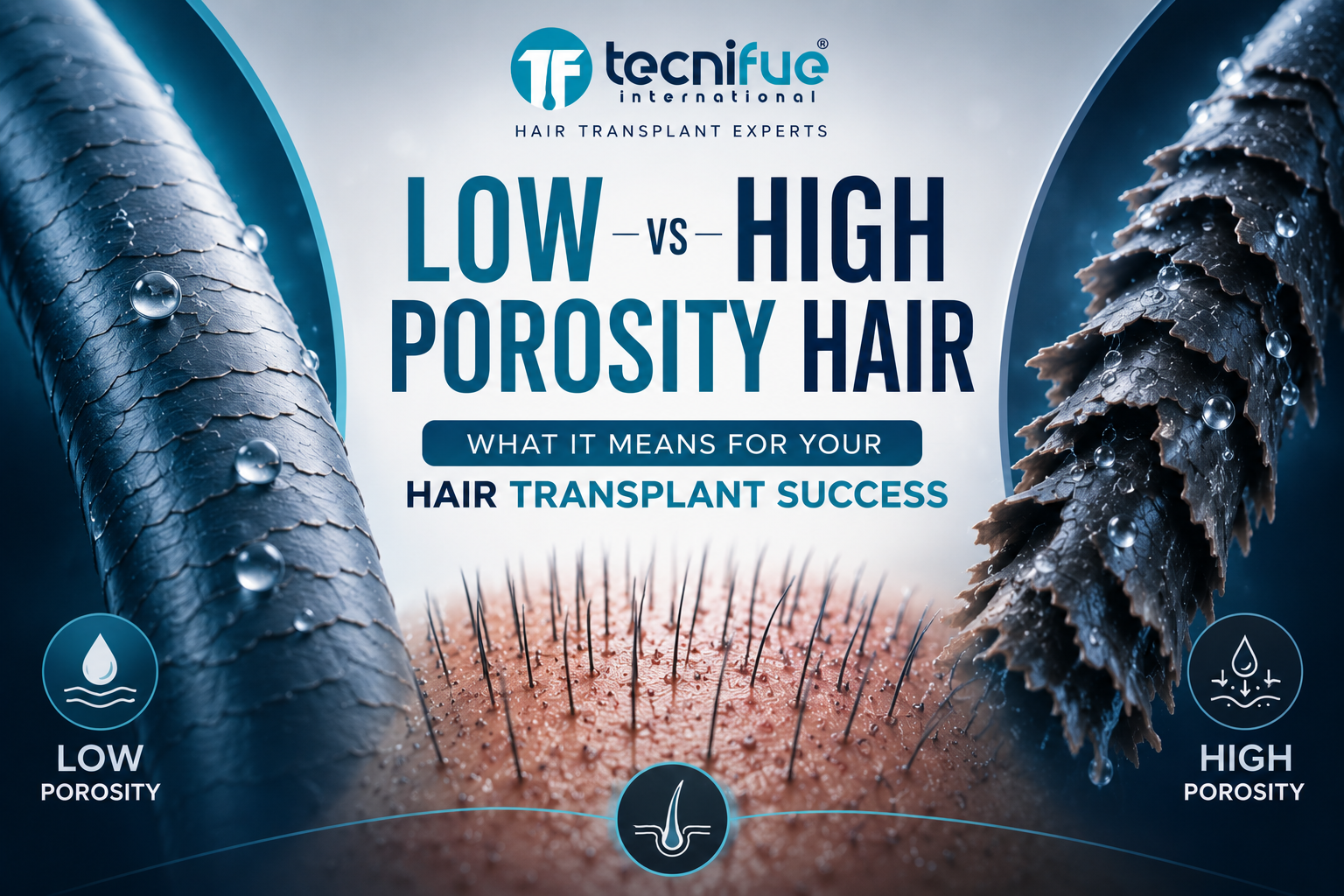

Quick Answer: Hair porosity is your hair’s ability to absorb and retain moisture, determined by how tightly the cuticle layer (the shingle-like outer surface of each strand) is sealed. Low porosity hair has flat, tightly packed cuticles that resist water and dry slowly, while high porosity hair has raised or damaged cuticles that soak up moisture fast but lose it just as quickly. Neither type is “bad,” but knowing yours changes how you should wash, condition, and, if you’re considering a hair transplant, how you should manage your scalp before and after the procedure.
Key Takeaways
- Porosity is about the cuticle, not thickness. Tightly sealed cuticles = low porosity; lifted or gapped cuticles = high porosity. Strand thickness is a separate trait.
- You can test it at home in under 5 minutes using the float test or the spray bottle test, no lab required.
- Low porosity hair resists moisture, dries slowly, and is prone to product buildup, but is typically more resilient.
- High porosity hair absorbs water instantly, dries fast, frizzes easily, and often signals cuticle damage from heat, bleach, or UV exposure.
- Medium porosity hair sits in the middle and is generally the easiest to manage and style.
- Porosity does not decide whether grafts survive, but it shapes post-transplant washing, moisturizing, and drying routines that protect healing follicles.
Roughly every guide on this topic tells you how to bounce water off a strand of hair. Very few explain what porosity actually means for the health of your scalp, and almost none connect it to the one decision where scalp condition genuinely matters: a hair transplant. This guide covers both.
What Is Hair Porosity and Why It Matters
Hair porosity describes how easily moisture, oils, and products pass into and out of the hair shaft. It is one of the most useful (and most overlooked) traits for choosing a hair care routine, because two people using identical products can get opposite results purely due to different hair porosity levels.
Definition of Hair Porosity
Porosity is a physical property of the hair shaft structure, specifically of its outermost layer. A strand of hair has three layers: the medulla (core), the cortex (the protein-rich middle that gives hair its strength and color), and the cuticle (the protective outer layer). Porosity is set by the condition of that outer layer.
Think of it like roof shingles. Flat, overlapping shingles keep rain out. Lifted or missing shingles let water pour in, and let it evaporate right back out.
The Role of the Cuticle Layer
The cuticle layer is made of 5 to 10 overlapping sheets of flattened, keratinized cells, and its angle determines everything. When cuticle cells lie flat, water beads on the surface instead of penetrating: that’s low porosity. When they lift, chip, or erode, the cortex is exposed, moisture rushes in and out freely, and the strand becomes fragile: that’s high porosity.
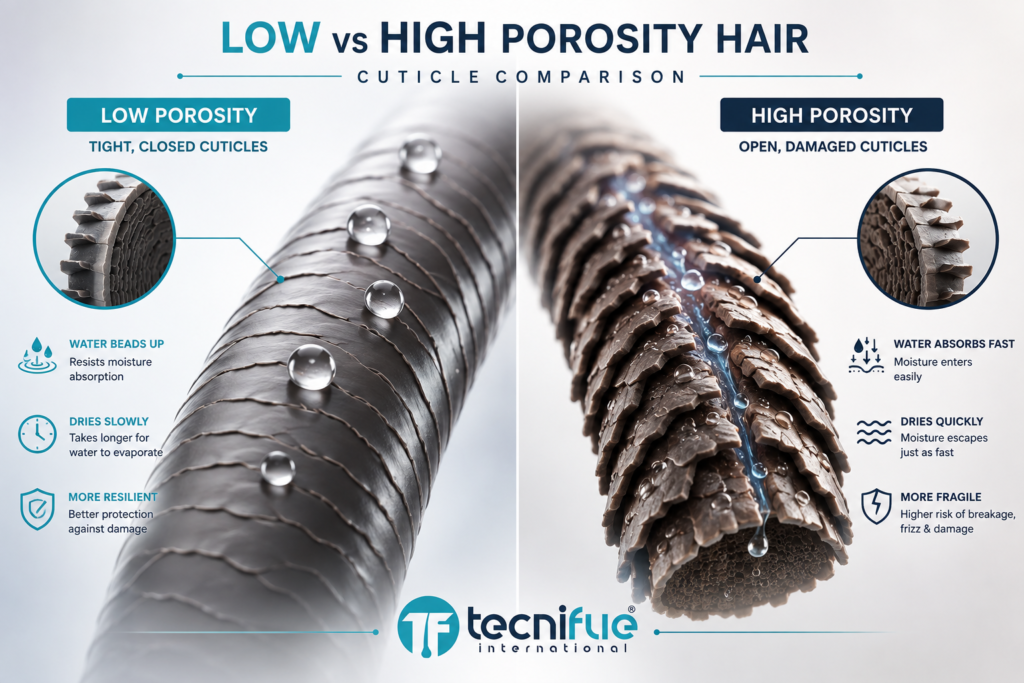
This is also why porosity affects color treatments, conditioning, and even how shiny hair looks. Light reflects evenly off a smooth cuticle, which is why low porosity hair often appears glossier.
Genetic vs. Environmental Factors
Your baseline porosity is genetic, but your current porosity is often earned. Many people are born with low or medium porosity hair and push it toward high porosity through:
- Chemical processing: bleach, permanent color, relaxers, and perms all force the cuticle open
- Heat styling: flat irons and hot blow-drying above roughly 180°C / 356°F degrade cuticle proteins over time
- UV exposure and chlorine: both weather the cuticle gradually
- Mechanical stress: aggressive brushing, tight styles, rough towel-drying
This answers a common question directly: can hair porosity change over time? Yes. Damage raises porosity, and while a damaged cuticle can’t fully “heal” (hair is not living tissue once it leaves the follicle), new growth from a healthy scalp comes in at your genetic baseline. That’s a key detail for transplant patients, and we’ll come back to it.
Low Porosity Hair: Signs and Characteristics
Low porosity hair has a tightly sealed cuticle that repels moisture, which makes it slow to wet, slow to dry, and quick to accumulate product buildup. If your hair takes hours to air dry and conditioners seem to sit on top of it, this is probably you.
How Low Porosity Hair Behaves
The most recognizable low porosity hair characteristics show up at the sink and in the shower:
- Water beads up or rolls off strands before soaking in
- Hair takes noticeably long to get fully saturated, and even longer to air dry
- Products (especially heavy butters and oils) sit on the surface and leave a coated, greasy feel
- Hair often looks smooth and shiny because the flat cuticle reflects light well
- Protein-heavy treatments can make it feel stiff or straw-like
Common Struggles and Advantages
The struggle is absorption; the advantage is protection. Because the cuticle is sealed, low porosity hair resists chemical and environmental damage better than other types and tends to hold its structure well. The trade-off is that deep conditioners underperform unless you help them along with warmth (a warm towel or steam opens the cuticle slightly), and buildup from low porosity hair products accumulates fast, which can suffocate the scalp environment if you never clarify.
One thing most guides skip: buildup on a low porosity head isn’t just a hair problem. Residue accumulating at the roots can trap sebum and irritate the scalp, and scalp condition, not strand condition, is what drives hair growth.
High Porosity Hair: Signs and Characteristics
High porosity hair has raised, gapped, or damaged cuticles that absorb water within seconds but cannot hold onto it, leading to dryness, frizz, tangling, and breakage. It is often (though not always) the result of chemical or heat damage.
How High Porosity Hair Behaves
Typical high porosity hair characteristics include:
- Hair gets soaked almost instantly in the shower
- Air drying is fast, sometimes under 30 minutes
- Frizz appears in humid weather because strands pull moisture from the air unevenly
- Hair tangles easily and feels rough when you slide fingers up a strand (against the cuticle)
- Color fades quickly, and hair may look dull because a lifted cuticle scatters light
Common Struggles and Advantages
The main struggle is retention: moisture, color, and treatments all escape quickly, and the exposed cortex is prone to breakage. The upside is that high porosity hair drinks in conditioners, oils, and masks with zero resistance, so treatments act fast. Rich high porosity hair products (leave-in conditioners, sealing oils like argan, protein-moisture balanced masks) can visibly improve texture within a few washes because the cuticle isn’t blocking anything.
If your hair was low porosity years ago and behaves like this now, that’s a damage signal worth acting on, not just styling around.
Medium Porosity Hair: The Balanced Middle
Medium porosity hair has cuticles that are neither sealed shut nor blown open, so it absorbs moisture at a moderate pace and holds it well. This is the easiest type to manage: it takes color predictably, holds styles, responds to most products, and needs the least specialized care. Many people with medium porosity hair don’t realize porosity exists, because nothing about their hair fights them.
Even so, medium porosity can drift toward high porosity with repeated heat and chemical use, so the maintenance goal is simple: don’t break what works.
How to Test Your Hair Porosity at Home
You can determine your porosity type at home in under 5 minutes with two simple tests, using nothing but clean hair, a glass of water, and a spray bottle. Always test freshly washed, product-free hair; silicones and oils on the strand will skew both tests.
The Float Test
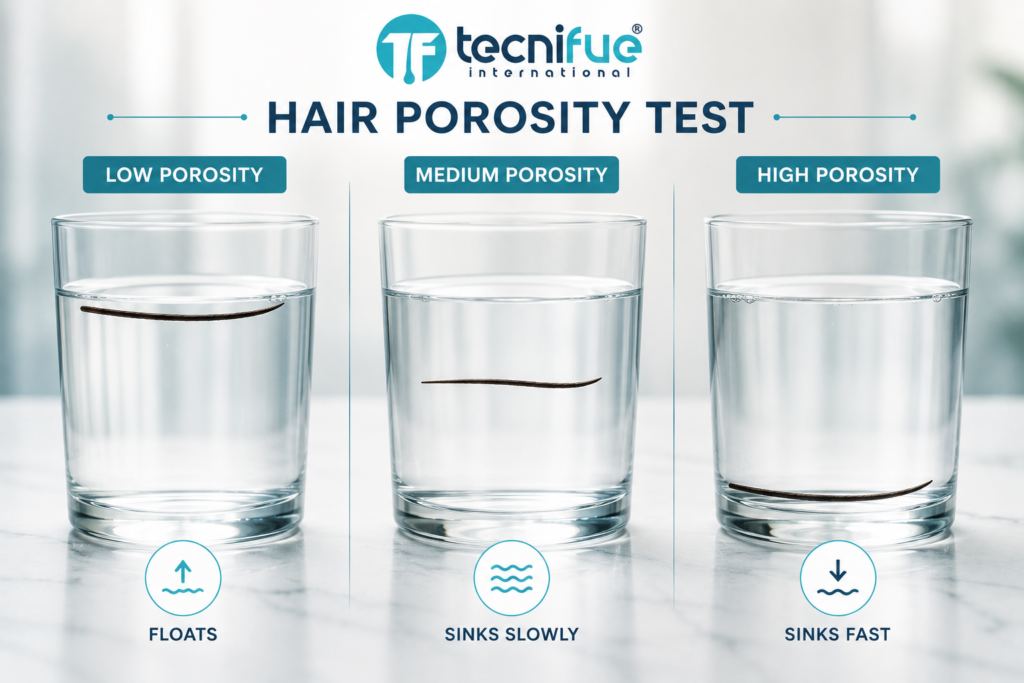
The float test for hair porosity is the classic method:
1. Wash your hair with a clarifying shampoo and let it dry with no products.
2. Take 2-3 shed strands (from your brush, not plucked).
3. Drop them into a glass of room-temperature water.
4. Wait 3-5 minutes and observe.
Reading it: strands that float the entire time suggest low porosity; strands that sink within a minute or two suggest high porosity; strands that hover mid-glass suggest medium porosity.
The Spray Bottle Test
The spray bottle test is arguably more reliable because it observes hair on your head rather than a detached strand:
1. Mist a small section of clean, dry hair lightly with water.
2. Watch for 1-2 minutes.
Reading it: if water beads sit on the surface, you’re low porosity. If the section darkens and absorbs the mist almost immediately, you’re high porosity. Somewhere in between, absorbing within a minute or so, points to medium porosity.
Reading Your Results
Test 2-3 different areas of your head before you conclude anything. Porosity is rarely uniform: the hair at your crown and ends (older, more weathered) often tests higher than hair near the nape. If your ends test high but your roots test low, that’s damage-driven porosity, not genetics, and it usually means your new growth is healthier than your lengths.
There’s no formal hair porosity quiz that beats these two physical tests. Water doesn’t lie.
Low vs High Porosity Hair: Side-by-Side Comparison
The clearest way to settle the low porosity hair vs high porosity hair question is to line the traits up directly:
| Trait | Low Porosity Hair | High Porosity Hair |
| Cuticle state | Flat, tightly sealed | Lifted, gapped, or damaged |
| Water absorption | Slow; water beads on surface | Instant; strands soak through in seconds |
| Drying time | Long (hours to air dry) | Short (often under an hour) |
| Moisture retention | Holds moisture well once absorbed | Loses moisture rapidly |
| Product response | Prone to buildup; products sit on top | Absorbs products fast; needs sealing |
| Frizz & tangling | Minimal | Frequent, especially in humidity |
| Shine | Typically glossy | Often dull or rough |
| Damage resistance | High | Low; prone to breakage |
| Best product weight | Lightweight, water-based | Rich creams, leave-ins, sealing oils |
| Common cause | Genetics | Genetics + heat/chemical/UV damage |
Water Absorption and Retention
The paradox worth understanding: low porosity hair is hard to moisturize but easy to keep moisturized, while high porosity hair is easy to moisturize but nearly impossible to keep moisturized without sealing. That single sentence explains about 80% of “why doesn’t my conditioner work” complaints.
Styling and Product Response
Low porosity hair rewards patience and lightweight formulas; high porosity hair rewards layering (liquid, then cream, then oil to seal). Heat behaves differently too: a little warmth helps products penetrate low porosity hair, while additional heat on high porosity hair usually deepens the damage that caused the porosity in the first place.
Scalp and Follicle Implications
Here’s the part competitors rarely address: porosity describes the strand, but strand condition reflects what’s happening at the scalp. Sebum production, your scalp’s natural conditioning system, coats low porosity hair slowly (it struggles to travel down tightly-cuticled strands, especially curly ones) and disappears into high porosity hair without much protective effect. Scalp moisture balance therefore needs active management in both cases: clarifying to prevent buildup on low porosity scalps, and gentle hydration to offset the constant moisture loss around high porosity hair.
Does hair porosity affect hair growth? Not directly. Growth happens at the follicle, beneath the skin, where porosity has no reach. But indirectly, yes: high porosity hair breaks before it gains length (so it seems to “stop growing”), and buildup or chronic scalp irritation can degrade the follicle environment over time.
Why Hair Porosity Matters for Transplant Candidates
Porosity does not determine whether a hair transplant succeeds, but it directly shapes the aftercare routine that protects your grafts during the critical first weeks. If you’re researching a procedure, knowing your porosity type before surgery lets you plan a recovery routine instead of improvising one.
Scalp Health and Graft Environment
Graft survival depends on the recipient site: circulation, cleanliness, and freedom from irritation. A scalp buried under years of product buildup (a common low porosity pattern) or chronically dry and inflamed (common alongside high porosity hair) is worth optimizing in the 4-8 weeks before surgery. Reputable clinics assess scalp condition during consultation for exactly this reason; at Tecnifue International in Istanbul, scalp evaluation is part of the standard pre-operative hair analysis rather than an afterthought.
Is low porosity hair better for grafts? Not meaningfully. Grafts are harvested with the follicle intact, and the follicle, not the visible strand, produces the new hair. What matters more is that transplanted hair grows in at your genetic baseline porosity. If your existing hair is high porosity from years of heat and color damage, your transplanted growth may actually come in healthier-looking than the hair around it, provided you don’t repeat the damage.
One practical note: characteristics like curl pattern and strand caliber do influence how a surgeon plans density and hairline design, which is worth raising during consultation. You can see how these variables play out in real cases by reviewing documented hair transplant results at 12 months, where texture differences between patients are clearly visible.
Post-Procedure Hair Care Considerations by Porosity Type
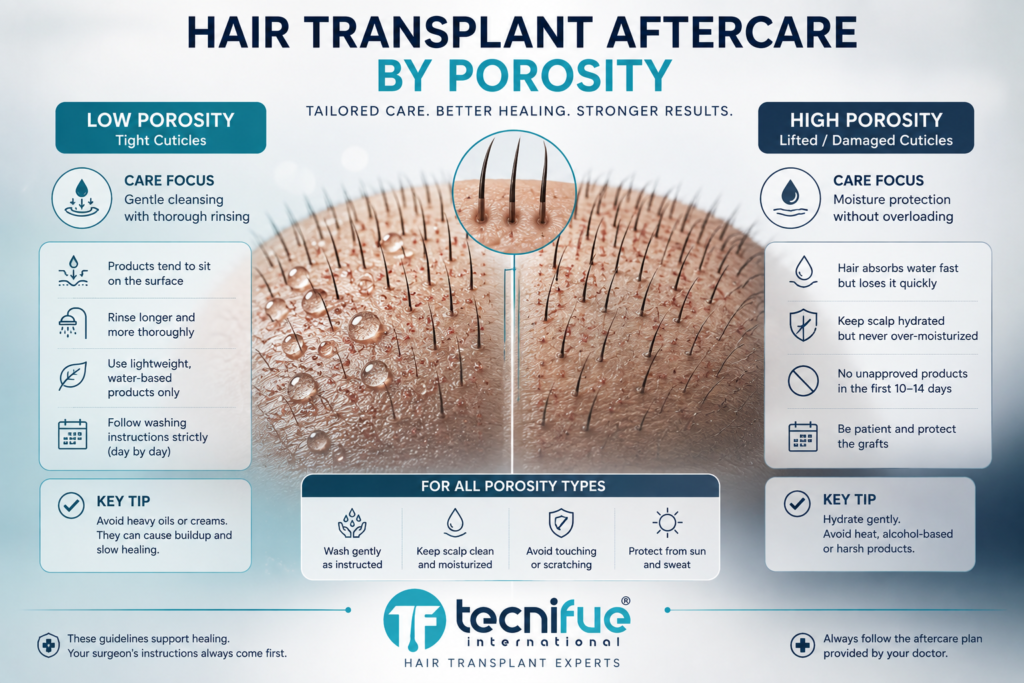
The first 10-14 days after an FUE procedure involve strict, gentle washing protocols, and porosity changes how those feel in practice:
- Low porosity patients: post-op foams and lotions will sit on the hair and scalp longer. Rinse thoroughly but gently; residue accumulates faster on your hair type. Expect longer air-drying times, and never rub, blot only.
- High porosity patients: your existing hair will feel drier than usual during recovery because heat styling, oils, and most leave-ins are off-limits initially. This is temporary. Follow your clinic’s product list rather than reaching for your usual sealing oils, and reintroduce them only when cleared.
- Everyone: no heat, no harsh shampoos, no scratching, regardless of porosity.
Detailed day-by-day washing and drying guidance is covered in this FUE recovery guide for the first 10 days, which pairs well with knowing your porosity type in advance.
Transplanted hair typically sheds around weeks 2-8 (shock loss), then regrows over 6-12 months. As that new hair comes in, treat it as what it is: virgin, baseline-porosity hair. Protect it from the heat and chemical habits that may have raised your original hair’s porosity, and it will stay in the healthy range. Month-by-month expectations are laid out in this DHI results timeline over 12 months if you want to map porosity care to each growth stage.
Caring for Your Hair Based on Porosity Type
Effective porosity care comes down to one principle each: help moisture in (low porosity) or lock moisture in (high porosity). Product marketing complicates this endlessly; the mechanics don’t.
Best Practices for Low Porosity
- Choose lightweight, water-based products. Heavy butters (shea, castor) tend to coat rather than absorb. The best low porosity hair products list water or aloe high in the ingredients.
- Use warmth to open the cuticle. Apply deep conditioner, then cover with a warm towel or shower cap for 15-20 minutes.
- Clarify regularly. A clarifying low porosity hair shampoo every 2-4 weeks strips buildup and resets the scalp.
- Pick penetrating oils over sealing oils. Lighter options like argan or grapeseed work better as a low porosity hair oil than heavy coating oils.
- Apply products to damp, warm hair, never dry hair, where they’ll just sit.
Best Practices for High Porosity
- Layer and seal. Water-based leave-in first, cream second, a few drops of oil last to trap moisture at the cuticle.
- Balance protein and moisture. Protein treatments temporarily fill cuticle gaps; alternate them with moisture masks so hair doesn’t turn brittle.
- Cut heat dramatically. Air dry when possible; if you must use heat, stay low and always use protectant.
- Rinse with cool water to encourage the cuticle to lie as flat as it can.
- Trim damaged ends. Past a certain point, no product rebuilds a shattered cuticle; removing the worst-affected length is the honest fix.
If you follow only one rule per type: low porosity, clarify more; high porosity, seal more.
Not sure how your hair’s porosity might affect your transplant recovery? Book a free consultation with Tecnifue International to get a personalized scalp and hair analysis.
Frequently Asked Questions
How can I know if I have low or high porosity hair?
Run the spray bottle test on clean, product-free dry hair. Water beading on the surface for a minute or more indicates low porosity; instant absorption indicates high porosity. Confirm with the float test (floating strands = low, sinking strands = high) and test 2-3 areas of your head, since ends often test higher than roots.
What is healthier, low or high porosity hair?
Neither is inherently “healthy” or “unhealthy,” but genetically low or medium porosity hair is generally more resilient, while high porosity is often a marker of accumulated damage. If your hair shifted from low to high porosity over the years, that shift, not the label itself, is the health signal to address.
Do Asians have low or high porosity hair?
Straight, thick-cuticled hair common in East Asian populations tends toward low porosity, but this is a tendency, not a rule. Porosity varies widely within every ethnicity, and chemical or heat damage raises porosity regardless of genetic starting point. Test your own hair rather than assuming by background.
Will a hair transplant change my hair’s porosity?
No. Transplanted follicles produce hair at your genetic baseline porosity, the same as the donor area they came from. If your donor hair at the back of the head is healthy and low-to-medium porosity, new transplanted growth typically comes in at that quality, even if your existing top hair is damaged and high porosity.
Should I fix my scalp condition before getting a hair transplant?
It’s strongly advisable. Spending 4-8 weeks before surgery clarifying buildup (low porosity) or calming dryness and irritation (high porosity) gives grafts a healthier recipient environment. A quality clinic will evaluate your scalp during consultation and flag anything worth treating first; conditions like active dermatitis are typically addressed before scheduling surgery.
Can I use my regular porosity-specific products right after a transplant?
Not immediately. For roughly the first 2 weeks, use only the wash products your clinic provides or approves, regardless of your porosity type. Sealing oils, heavy leave-ins, and clarifying shampoos are usually reintroduced gradually after the grafts have anchored, with your clinic’s clearance.
Reviewed by hair specialist Mrs. Ayşe Çağla at TecniFUE International.