

Coconut Oil for Hair: Benefits and How to Use It (2026)
Quick answer: Coconut oil for hair is an effective pairing for one specific goal: reducing protein loss from the hair fiber. Thanks to its lauric acid, coconut oil penetrates the strand, limits breakage, and adds shine and softness. It won’t make your hair grow faster, but it protects your lengths, especially when used as a pre-shampoo oil treatment.
Key Takeaways
- Lauric acid (45-55% of its composition) allows coconut oil to genuinely penetrate the hair fiber, unlike most oils.
- Its main benefit: reducing the hair’s protein loss, and therefore breakage and split ends.
- It does not speed up growth: hair growth depends on the follicle, not on the length of the strand.
- Ideal use: an oil soak of 30 minutes up to overnight before shampooing, 1 to 2 times per week.
- Dry, curly, and coily hair benefit the most; fine and oily hair should avoid it on the scalp.
- After a hair transplant, wait at least 2 to 4 weeks before applying anything to the operated area.
What Is Coconut Oil and Why Is It So Popular for Hair?
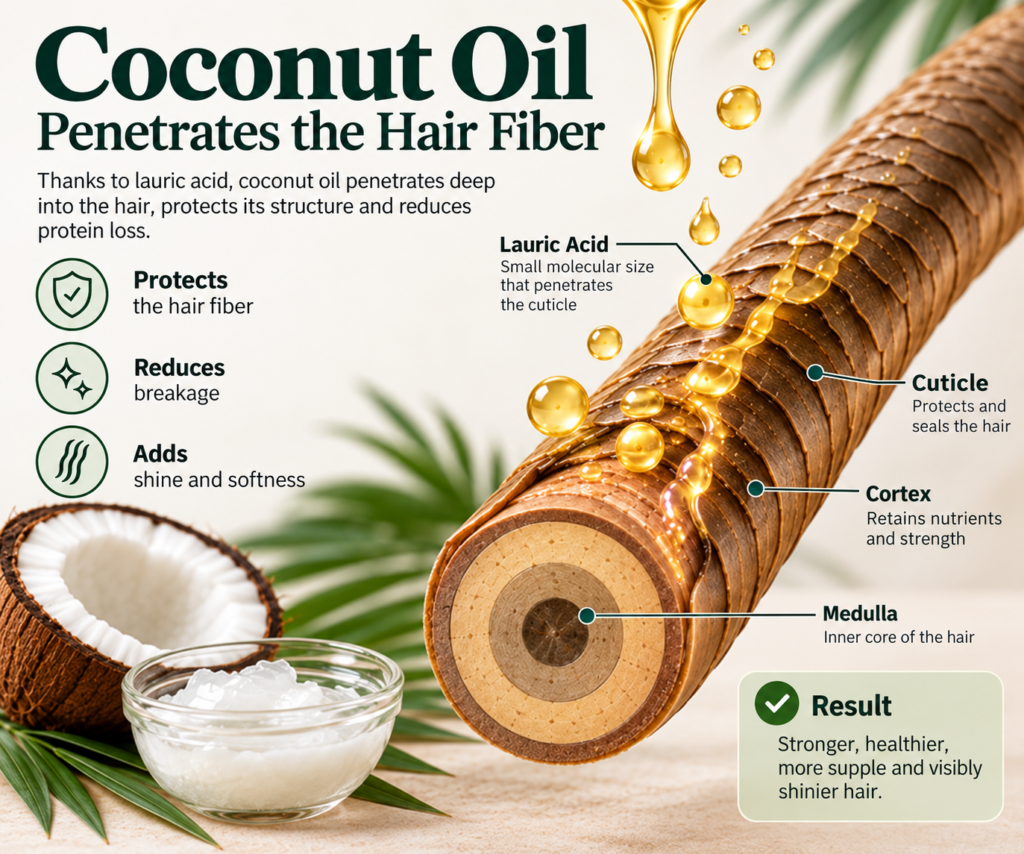
Coconut oil is a plant oil extracted from the flesh of the coconut, and its high lauric acid content allows it to penetrate the hair fiber instead of sitting on the surface. This property, rare among plant oils, explains why coconut oil for hair is so popular worldwide in hair care.
💡 What is lauric acid? A medium-chain fatty acid whose small molecular size and affinity with hair keratin let it pass through the hair’s cuticle.
💡 What is lauric acid? A medium-chain fatty acid whose small molecular size and affinity with hair keratin let it pass through the hair’s cuticle.
For hair care, choose a virgin coconut oil for the hair (cold-pressed, unrefined): it keeps its fatty acids intact. A refined or hydrogenated oil loses some of its properties. To the question “which coconut oil is best for hair,” the answer is simple: virgin, organic if possible, with no added fragrance.
What Are the Real Coconut Oil Hair Benefits?
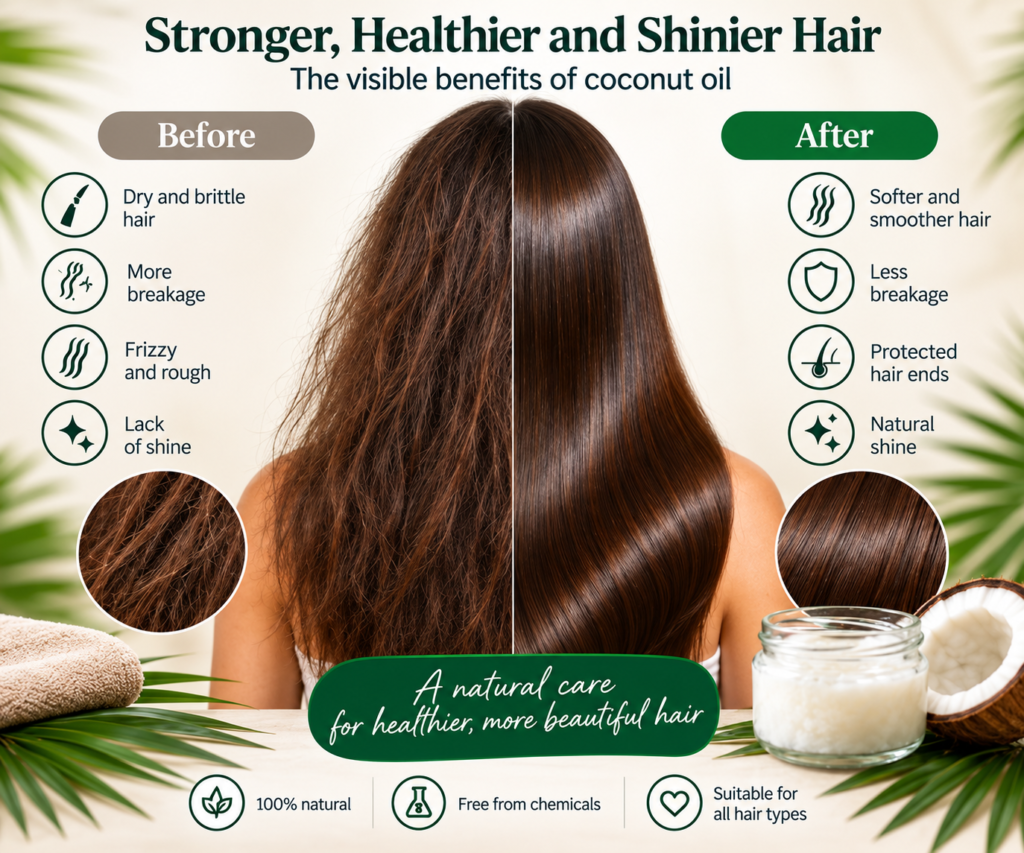
The best-documented coconut oil hair benefits are reduced protein loss, less breakage, and a visible boost in shine. Several scientific studies on hair care have shown that coconut oil, applied before or after washing, reduces the hair’s protein loss, something mineral oils do not achieve.
In practical terms, regular use delivers:
- Less breakage: a fiber saturated with lipids resists brushing and friction better.
- Delayed split ends: the oil doesn’t repair an existing split end, but slows its appearance.
- Shine and softness: a smoothed cuticle reflects light more effectively.
- A soothed scalp: its antimicrobial properties may help with dryness or mild dry dandruff.
When it comes to coconut oil for hair reviews, the most common feedback in before/after cases is visibly softer lengths after just 2 to 3 applications. What many forget: on hair that is already saturated with protein, the effect can reverse and stiffen the fiber. To truly understand what coconut oil does for hair, treat it as a targeted treatment, never as a cure-all.
Does Coconut Oil Really Make Hair Grow Faster?
No, coconut oil and hair growth are not directly linked: no serious study shows it accelerates growth. Hair grows about 1 to 1.5 cm per month (roughly 0.4 to 0.6 inch), a pace set by the hair follicle, genetics, and hormones.
That said, coconut oil for hair growth works “in appearance”: by reducing breakage, it lets you keep more length. The distinction is essential. A cosmetic treatment protects existing hair; it does not treat androgenetic or hormonal hair loss. In the face of diffuse or localized shedding, the medical causes of hair loss should be explored with a professional before expecting results from any oil.
Expert note: in hair consultations, confusing breakage (hair that snaps) with shedding (hair that falls from the follicle) is the most common mistake. Coconut oil works on the first, never on the second.
Expert note: in hair consultations, confusing breakage (hair that snaps) with shedding (hair that falls from the follicle) is the most common mistake. Coconut oil works on the first, never on the second.
How to Use Coconut Oil for Hair the Right Way
The most effective method is coconut oil applied before shampoo, as an oil soak of at least 30 minutes, 1 to 2 times per week. Apply to dry hair from the mid-lengths to the ends, then wash.
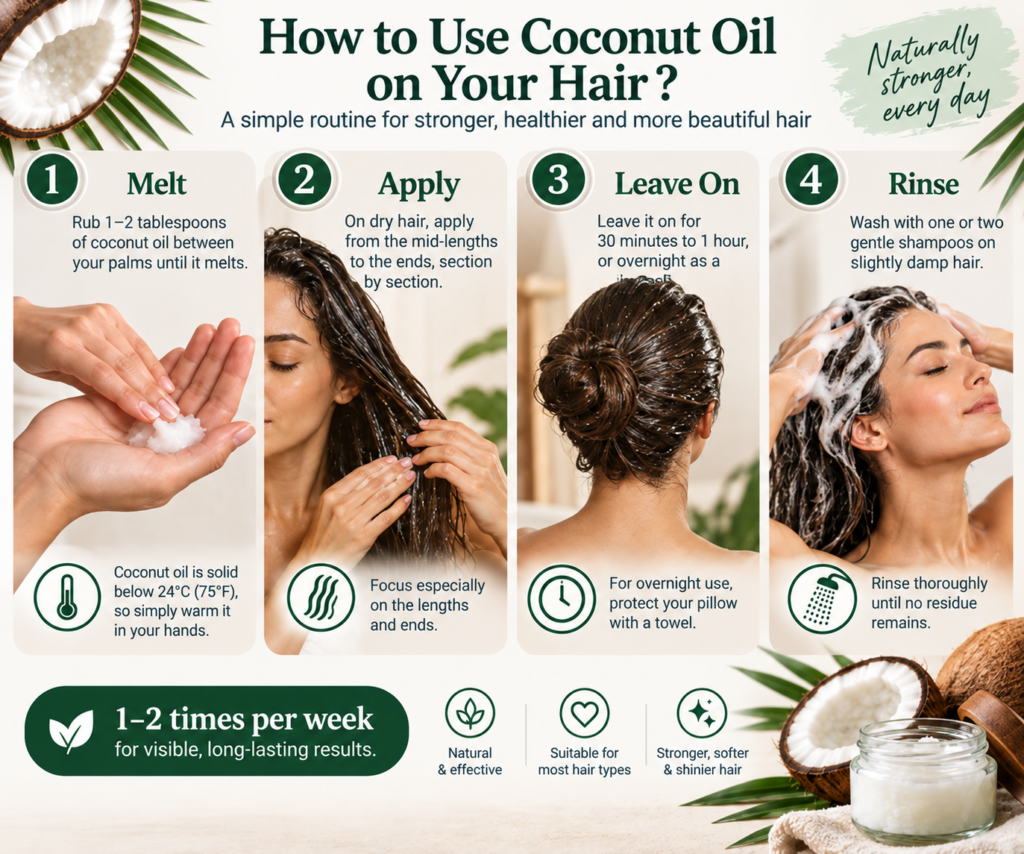
- Melt 1 to 2 tablespoons between your palms (the oil is solid below 75°F / 24°C).
- Apply to lengths and ends, section by section.
- Leave on 30 minutes to 1 hour; for an overnight coconut oil hair mask, protect your pillow with a towel.
- Rinse with one or two gentle shampoos on barely damp hair for better emulsifying.
On the scalp, limit coconut oil to a light 20-30 minute massage in case of dryness, and avoid it entirely if you tend to have oily roots. As a leave-in, a micro-dose (about the size of a pea) is enough, on the ends only.
Coconut Oil for Hair by Fiber Type
Coconut oil doesn’t suit every hair type the same way: dry, curly, and coily hair get the most out of it, while fine hair risks a stiff, straw-like effect. Your fiber’s porosity changes everything, a factor detailed in guides on hair care based on your porosity.
| Hair type | Application method | Leave-on time | Frequency |
|---|---|---|---|
| Dry / damaged | Oil soak on lengths + ends | 1 h to overnight | 1-2 times/week |
| Curly | Pre-shampoo mask | 30 min to 1 h | 1 time/week |
| Coily / textured | Oil soak or leave-in sealing | 1 h to overnight | 1-2 times/week |
| Fine / oily | Ends only, micro-dose | 20-30 min | 1 time/week max |
| Gray / mature | Shine treatment on lengths | 30 min | 1 time/week |
For coily hair, coconut oil fits perfectly as a moisture-sealing step (the LOC method: liquid, oil, cream). On gray hair, which is often drier and more porous, it restores softness and radiance without yellowing the fiber, as long as it’s virgin and fragrance-free.
Coconut Oil and Hair Transplants: Precautions to Know
After a hair transplant, do not apply any oil to the operated area before your medical team approves it, generally at least 2 to 4 weeks. The grafts need this period to anchor, and a fatty substance applied too early can interfere with healing and the scabs.
Once that window has passed, coconut oil can help soften a tight scalp and calm the itching of regrowth. The post-op protocols for a FUE hair transplant in Turkey actually include specific instructions on which care steps are allowed week by week. Your medical team or clinic recommends always clearing every product applied to the recipient area during the first 3 months.
Risks, Limits, and Alternatives to Coconut Oil
The main risk with coconut oil is buildup: too frequent or poorly rinsed, it weighs the hair down, oils the roots, and can stiffen low-porosity fibers. Hair that turns straw-like despite treatment is the classic signal to stop.
Complementary alternatives depending on your goal:
- Castor oil: the most cited for strengthening and boosting the appearance of density, thicker in texture.
- Argan oil: lighter, ideal as a leave-in finish on fine hair.
- Avocado oil: also penetrating, a good option for very porous fibers.
No oil treats medically driven hair loss. When shedding is established, approaches like hair mesotherapy or a complete scalp assessment remain the serious paths to explore.
FAQ: Your Questions About Coconut Oil and Hair
How long should you leave coconut oil in your hair?
Between 30 minutes and 1 hour for a standard oil soak, up to a full night for very dry or coily hair. Beyond 12 hours, no additional benefit of coconut oil on hair has been demonstrated.
Coconut oil before or after shampoo?
Before, in the vast majority of cases: a pre-shampoo oil soak protects the fiber during washing. After shampooing, reserve it for the ends in minimal amounts, otherwise a greasy effect is guaranteed.
How do you rinse coconut oil out of your hair?
Apply shampoo directly to the oiled hair while it’s barely damp, massage to emulsify, then rinse. Repeat a second time if needed. Very hot water is unnecessary and stresses the fiber.
Coconut oil on hair: how many times per week?
1 to 2 times per week for dry, curly, or coily hair; 1 time maximum for fine hair, and on the ends only.
What is the best oil for hair growth?
No oil objectively makes hair grow faster. Castor oil and coconut oil reduce breakage, which preserves length. To stimulate real regrowth, only validated medical treatments act on the hair follicle.
This article is intended for informational and educational purposes; it is not a substitute for personalized medical or dermatological advice.

How we reviewed this article:
Current Version
September 12, 2026September 14, 2026
Written By