

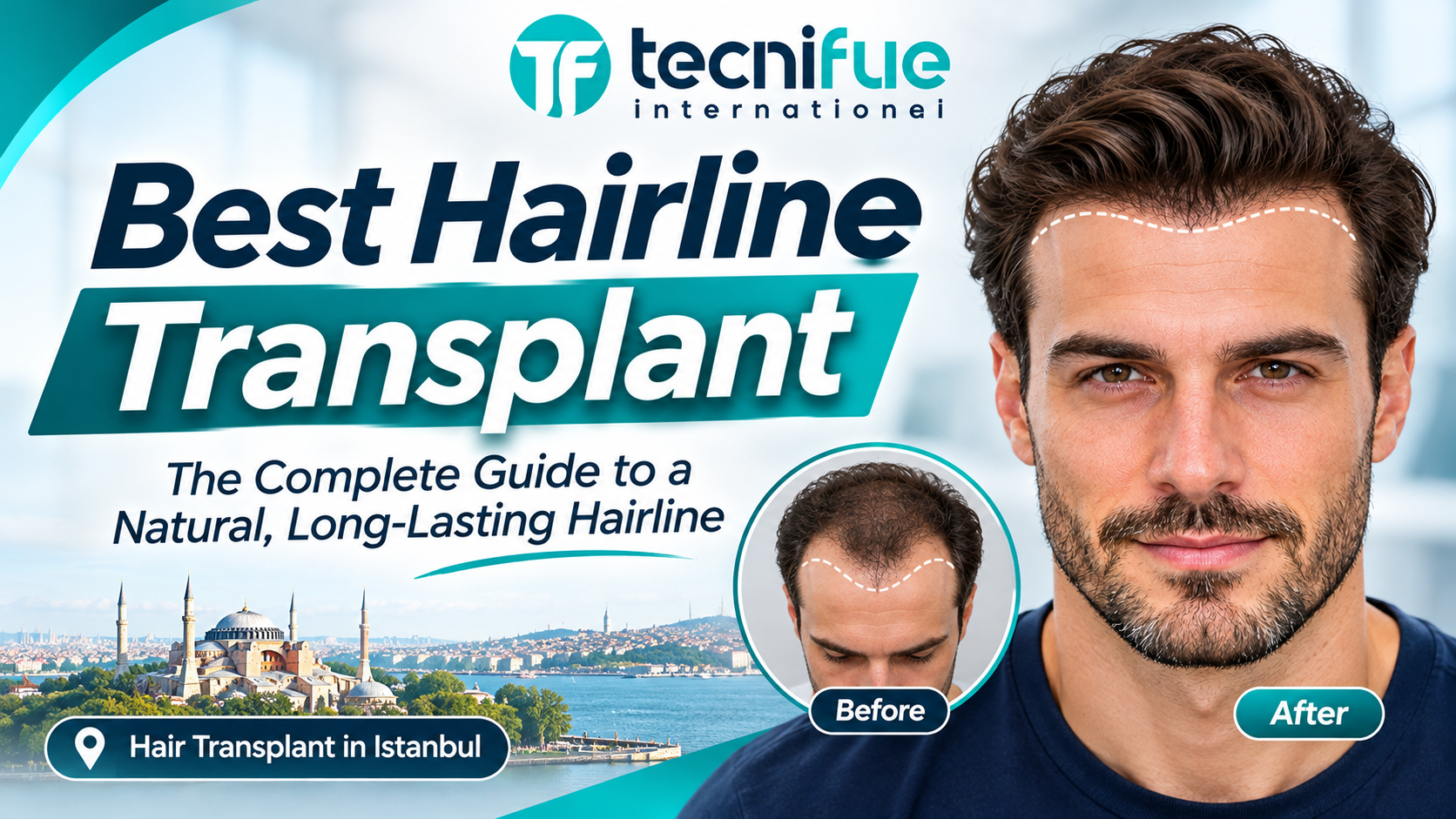

Quick Answer: The best hairline transplant result depends not only on the technique but also on the design. A natural hairline transplant should be designed with age-appropriate temple recession, a density of 1–2 FU/mm along the frontal edge, and irregular, feathered graft placement. Rather than creating a perfectly straight “fence-like hairline”, micro-irregularities, single-hair grafts placed at the front, and accurate mapping of the temporal points make the result virtually undetectable.
Key Takeaways
- The most common reason for an unsuccessful hairline transplant is not surgical error but poor design (a hairline that is too straight, too low, or inappropriate for the patient’s age).
- For a natural appearance, only single-hair grafts should be placed in the front row, while double- and triple-hair grafts are positioned behind them.
- A typical hairline restoration surgery requires 800–1,800 grafts, depending on the area. In Norwood 3–4 cases, the total number of grafts for the frontal area may reach 2,000–2,500.
- The DHI technique offers an advantage in angle and direction control along the frontal hairline, while FUE provides greater speed and flexibility for larger areas.
- When choosing a clinic, ask to see the surgeon’s hairline portfolio: review at least 5–10 cases involving patients with a similar age and degree of hair loss.
- The final result is achieved at 12 months. Reduced density between months 4 and 6 is normal.
What Is a Hairline Transplant and Why Is Design Everything?
A hairline transplant involves reconstructing a receding frontal hairline using grafts harvested from the donor area. Approximately 70–80% of aesthetic success is determined by design decisions before surgical skills even come into play. Grafts taken from the back of the head are resistant to the DHT hormone, which makes the results permanent. However, permanence does not necessarily mean a natural appearance. This is precisely why the best hairline transplant results are measured more by their natural appearance than by their longevity.
The most common surgical mistake is agreeing to a patient’s request to restore the hairline they had in their twenties. A frontal hairline positioned too close to the forehead and perfectly straight, as if drawn with a ruler, can look artificial in the patient’s forties. As hair loss progresses, it may also create an isolated “island” effect. A good surgeon must sometimes know when to say no to a patient.
💡 What Are the Frontal Hairline and Temporal Points? The frontal hairline is the front boundary of the hair along the upper forehead, while temporal points are the triangular hairline extensions located at the temples. Together, they frame the face. If the temporal points are neglected, the frontal hairline alone may look like the edge of a wig.
How Is the Best Hairline Transplant Designed?
The best hairline transplant design is based on three measurements: the perpendicular distance from the glabella (the point between the eyebrows) to the hairline (generally 7–9 cm in adult men), the position of the temporal points, and the proportions of the face’s three vertical thirds. Custom hairline design combines these measurements with the patient’s forehead muscles, facial shape, and future hair loss risk.
Natural Irregularity vs. a Straight “Fence-Like Hairline”
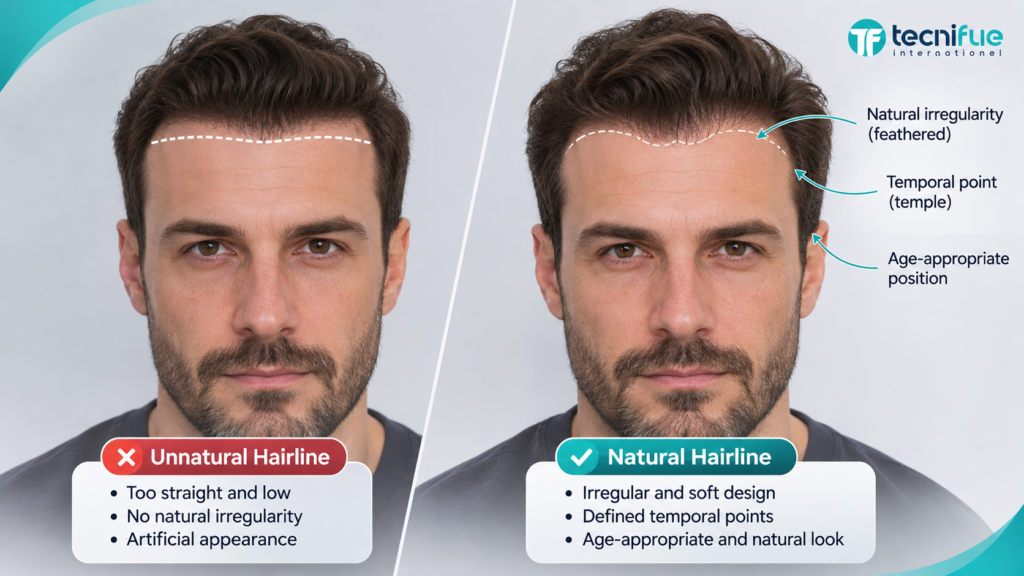
A natural hairline is never perfectly straight. It contains micro-irregularities, slight indentations and projections, and sometimes a widow’s peak (the V-shaped point in the middle of the forehead). With the natural hairline transplant approach, single-hair grafts are placed sparsely throughout the first 0.5–1 cm transition zone, with density gradually increasing towards the back. A sharp, uniform boundary is one of the most obvious signs of a hair transplant.
Age-Appropriate Positioning: The Mature Hairline Approach
A patient aged 43 should not be given the hairline of an 18-year-old. A mature hairline transplant positions the hairline 1–1.5 cm higher than a youthful hairline pattern, while maintaining slight and symmetrical recession at the temples. This approach requires fewer grafts and continues to look proportionate even 10–15 years later. For patients at Norwood 4–5, this also means preserving the donor reserve for the crown area. Being Norwood 5 at 43 is not “too late”; it simply requires prioritisation.
FUE vs. DHI: Comparing Techniques for the Ideal Hairline Transplant
For the frontal hairline, DHI offers greater precision in controlling angles and directions thanks to the implanter pen. FUE, particularly Sapphire FUE, provides greater speed and graft placement flexibility across larger areas. The donor harvesting method is the same in both techniques (individual follicle extraction); the difference lies in the implantation stage. In experienced hands, graft survival rates above 90% are generally reported with both techniques.
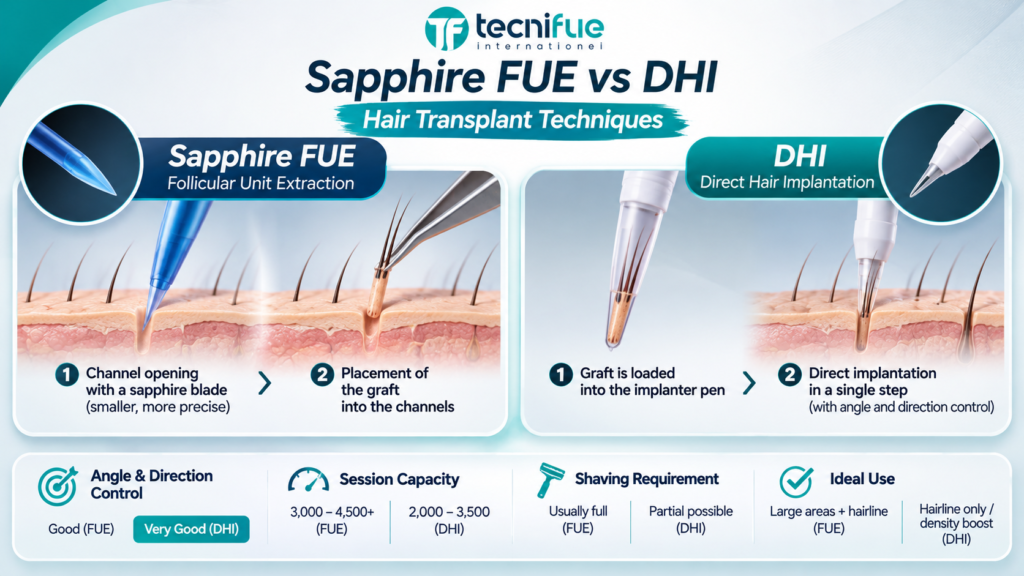
| Criteria | Sapphire FUE | DHI |
|---|---|---|
| Implantation | Channels are opened first, then grafts are placed | Single-step implantation using an implanter pen |
| Angle/direction control | Good | Very good (advantage for the hairline) |
| Session capacity | 3,000–4,500+ grafts | Generally 2,000–3,500 grafts |
| Shaving requirements | Usually full shaving | Partial shaving may be possible |
| Ideal application | Large areas combined with hairline restoration | Hairline only, density enhancement |
The practical reality is this: you are choosing the team performing the technique, not just the technique itself. DHI performed by an average surgeon will not produce better results than FUE performed by a highly skilled surgeon.
How Many Grafts Are Needed for a Natural Hairline Transplant?
A frontal hairline restoration alone typically requires 800–1,200 grafts, while including the temporal points increases the requirement to 1,200–1,800 grafts. For Norwood 3–4 patients, 2,000–2,500 grafts are generally planned for the entire frontal area. When it comes to hairline transplant results, density is a critical factor: targets of 35–45 FU per cm² in the mid-frontal area and 15–25 FU per cm² along the transition line are recommended for an undetectable result.
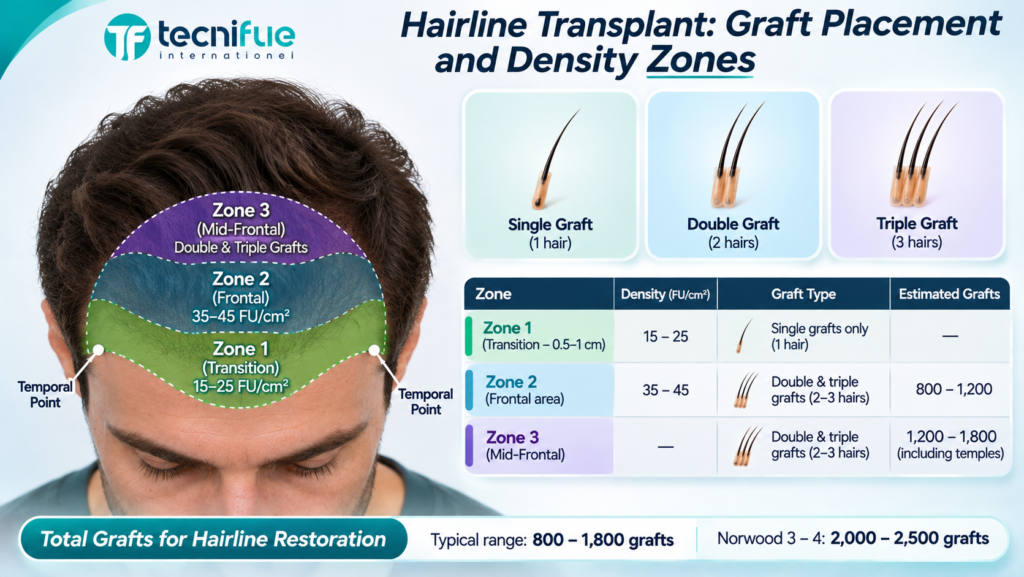
- Transition zone (first 0.5–1 cm): 15–25 FU/cm², single-hair grafts only
- Main frontal area: 35–45 FU/cm², double- and triple-hair grafts
- Temporal points: 150–300 grafts per side, implanted at a very low angle
- Crown transition (if applicable): Planned according to the remaining donor reserve
How to Choose the Best Hairline Transplant Clinic
The only reliable evidence when choosing the best hairline transplant clinic is an archive of the surgeon’s own hairline transplant before and after cases. Ask for photographs taken from different angles, under the same lighting conditions, showing results at least 12 months after surgery. Turkey is one of the countries with the highest hair transplant case volumes in the world. The issue is not the country itself, but the clinic’s operating model. At surgeon-led clinics based in Istanbul, such as tecnifueinternational, you can ask in writing who is responsible for the design and critical stages of the procedure. Avoid clinics that cannot provide a clear answer to this question.
Red flags to watch out for:
- Being asked “How many grafts would you like?” during the consultation (the graft count should be determined by the medical examination, not the patient).
- The same low and straight hairline being drawn for every patient.
- The hairline transplant surgeon only appearing on the day of surgery for photographs and leaving the design to technicians.
- Failure to provide verifiable result photographs taken at least 12 months after surgery.
- Unrealistic promises (“100% guarantee”, “no scars whatsoever”).
In terms of cost, realistic 2026 price ranges are as follows: a comprehensive procedure in the United States generally costs between $15,000 and $25,000, while all-inclusive packages in Turkey (surgery, hotel, transfers and medications) typically range from $2,500 to $5,500. The difference does not necessarily reflect lower quality; it is largely due to differences in labour and operating costs. Nevertheless, always request written confirmation of what the package includes (follow-up sessions, graft survival policies and remote monitoring).
From Surgery to the Final Appearance: The Recovery Timeline
The final natural appearance after hairline restoration surgery is achieved within 12 months. However, most patients feel socially comfortable after approximately 10–14 days. Patients working desk jobs can generally return to work within 3–7 days, while 3–5 days are usually sufficient before flying. Scabbing typically resolves within the first 10–14 days.
- Weeks 1–3: Redness subsides, and transplanted hairs temporarily shed due to “shock loss” (this is normal).
- Months 2–4: The dormant phase; new hairs have not yet emerged or are still very fine.
- Months 5–8: Visible thickening begins, and the hairline starts to take shape.
- Months 10–14: Hair shafts become thicker, and the natural-looking hairline reaches its final appearance.
FUE extraction points in the donor area are typically undetectable when the harvesting is performed correctly and the hair is kept at a length of 2–3 guard numbers (6–9 mm). They may be visible upon close inspection if the hair is shaved down to zero.
When a Hairline Transplant Goes Wrong: Avoiding and Correcting Mistakes
Yes, a hairline transplant can go wrong. The most common causes are design mistakes, incorrect implantation angles, and placing multi-hair grafts in the front row. Signs of a poor result include:
- A perfectly straight, symmetrical hairline, which does not occur naturally.
- Plug-like multi-hair grafts in the front row (“doll’s hair” effect).
- An excessively low hairline position that makes the face look disproportionate.
- Hair implanted at a steep angle, growing in the wrong direction.
- A frontal hairline that looks detached or suspended due to neglected temporal points.
Correction is possible: incorrectly placed grafts can be individually extracted using FUE and repositioned, while a straight hairline can be softened with single-hair grafts. However, revision surgery is more expensive than the initial procedure, both in terms of donor reserve and budget. The most affordable insurance is the 2–3 weeks of research you invest in choosing the right surgeon from the beginning.
Expert Note: Live with the hairline drawn during your consultation for 2–3 days, looking at it in the mirror at home. Good clinics photograph the design and send it to you, then review it together on the morning of surgery. A rushed approach that involves drawing the hairline in five minutes and immediately taking the patient into surgery is a warning sign.
Frequently Asked Questions
Which Hair Transplant Clinic in Turkey Is Considered the Best?
There is no single “best” clinic. The right question is which clinic is best suited to your individual case. The surgeon’s membership in international associations such as ISHRS, a verifiable archive of results at least 12 months after surgery, a low number of daily patients per surgeon, and a written aftercare policy are four essential criteria.
Which Hair Transplant Procedure Is the Most Successful?
With experienced teams, Sapphire FUE and DHI offer similar graft survival rates (generally above 90%). For hairline-focused procedures, DHI has a slight advantage due to its angle control, while Sapphire FUE is more practical for combining large-area restoration with hairline reconstruction. The quality of an ideal hairline transplant result is determined not by the name of the procedure, but by the skill of the professional performing it.
How Much Does 5,000 Grafts Cost in Turkey?
As of 2026, a comprehensive 5,000-graft hair transplant in Turkey generally costs between $3,000 and $6,000 with all-inclusive packages. The same procedure in the United States may exceed $20,000, based on an estimated cost of $4–8 per graft. However, transplanting 5,000 grafts in a single session is not safe or suitable for every patient; some cases need to be divided into two sessions.
Are Hair Transplant Procedures in Turkish Clinics Actually Performed by Doctors?
This varies from clinic to clinic and is one of the most important questions you should ask. In ethical clinics, the design, anaesthesia and channel opening are performed by the surgeon. Trained technicians may assist with graft implantation under the surgeon’s supervision. Always request written confirmation of who performs each stage of the procedure.
Did Donald Trump Have a Hair Transplant?
There is no publicly available, verified information confirming this. Claims in this regard are purely speculative. Rather than relying on celebrity examples, looking at verifiable patient cases with hair characteristics and hair loss patterns similar to your own provides a much more reliable basis for making your best hairline transplant decision.
What Happens If the Grafts Do Not Survive and I Have Already Returned to My Country?
Reputable clinics provide photographic remote follow-up for 12 months and may offer free or discounted revision procedures if the graft survival rate is significantly below expectations, in accordance with their written policies. Before making a reservation, make sure the terms of this policy are included in your contract before surgery, including the applicable thresholds and which costs are covered.
This content is intended for educational purposes only and does not replace an individual medical assessment or treatment recommendation. Always consult a qualified medical professional before deciding to undergo a hair transplant.